Ronald Brownstein: What's the endgame for Trump's offensive against blue cities?
Published in Op Eds
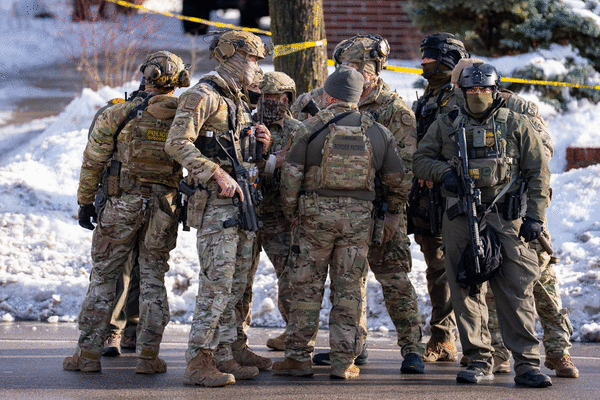
The siege of Minneapolis represents a fitting, if foreboding, capstone to the first year of President Donald Trump’s second term. Since returning to office one year ago, Trump has pursued no goal more passionately or persistently than breaking the ability of blue jurisdictions and their leaders to resist him.
In the process, he is straining the nation’s fundamental cohesion in ways that may escalate beyond his control.
Trump’s pressure campaign against blue states and cities is advancing along three major tracks.
The most visible is his use of physical force against blue municipalities. In Democratic-run cities including Los Angeles, Chicago, Portland, Charlotte and Minneapolis, heavily armed and masked federal immigration agents have swarmed neighborhoods and mustered for symbolic shows of force at prominent landmarks (such as MacArthur Park in Los Angeles and Michigan Avenue in Chicago), in a manner reminiscent of an occupying army.
Although immigrant communities have absorbed the brunt of this offensive, thousands of U.S. citizens and protesters have been swept up, too. Not since the segregationist Southern states deployed dogs, fire hoses and nightsticks against civil rights activists in the early 1960s has any government entity in the U.S. wielded force against its own citizens to this extent.
Looming over all of this is an even heavier club: the possibility that Trump might deploy the military into U.S. cities. After the Supreme Court stopped Trump from seizing control of state National Guard forces, he quickly pivoted to threatening Minneapolis with the deployment of active-duty troops under the Insurrection Act.
The second prong of Trump’s offensive against blue places is fiscal. The administration has sought to terminate federal funding to blue states and cities for virtually every major domestic purpose — including education, public health, infrastructure, transportation and law enforcement — unless they adopt a succession of conservative policies (on such issues as diversity, LGBTQ rights, abortion and, above all, complete cooperation with immigration enforcement) that they have rejected.
Courts have almost universally blocked these attempts as violating the underlying statutes establishing the federal programs. But the administration has responded by constantly devising new means of withholding money — for instance, by freezing child-care and welfare funds while they investigate fraud solely in five Democratic-controlled states. “They are forcing everyone who wants to uphold the rule of law to play a game of Whac-a-Mole with them,” says Jill Habig, founder and CEO of the Public Rights Project, a nonpartisan legal firm working with cities targeted by the administration.
Trump’s third front has been prosecutions of blue-state officials. The administration has already arrested a judge, a mayor, a U.S. representative and a city comptroller, all in Democratic cities, for allegedly physically interfering with immigration enforcement, either at protests or in other encounters.
The criminal investigation into Minneapolis Mayor Jacob Frey and Minnesota Governor Tim Walz raises the stakes by formally probing local officials over their words and policies — a step the administration threatened, but did not pursue, against Democratic Governors JB Pritzker and Gavin Newsom during the enforcement blitzes in Chicago and Los Angeles. This replicates a common tactic of authoritarian leaders: prosecuting dissenting local officials to signal to ordinary citizens that anyone who speaks out is vulnerable.
The intensity of Trump’s moves against the parts of the country that have resisted him is without exact precedent in American history. (The closest parallel may be President Andrew Johnson, who favored the South over the North when he ascended to the presidency following Abraham Lincoln’s assassination at the Civil War’s end in 1865.)
Eric Schickler, a political scientist at the University of California at Berkeley, points out that presidents more typically try to woo the places that voted against them. “I don’t think we have seen anything like that — where a president openly views the duly elected leaders of a series of states as just enemies … and those territories as not entitled to revenues,” said Schickler, co-author of Partisan Nation, a 2024 book on how partisan polarization has distorted the constitutional system. “I can’t imagine Franklin Roosevelt saying, ‘Maine and Vermont didn’t vote for me in 1936, therefore sorry — you are out of the New Deal.’”
Trump is inverting that electoral strategy: rather than courting blue places, he energizes his base by demonizing them. But his posture toward blue jurisdictions has a deeper and darker dimension. Trump and his top aides routinely describe Democratic officials as threats to the nation’s security and even survival — “the enemy from within,” in the president’s words. Deputy Attorney General Todd Blanche last week accused Walz and Frey of “terrorism.” Deputy White House Chief of Staff Stephen Miller, echoing his earlier comments about California and Illinois Democrats, told Fox they had “deliberately, willfully, and purposefully incited this violent insurrection.” In fact, the overwhelming evidence on the ground is that ordinary citizens in Minneapolis have peacefully exercised their First Amendment right to protest government actions.
Susan Stokes, director of the Center on Democracy at the University of Chicago, says it is likely no coincidence that Trump talked at length about his deployment of federal forces to Los Angeles and other cities at the press conference when he announced the capture of Venezuelan President Nicolas Maduro. “They are creating an equivalence between their antagonists in American cities and their antagonists in foreign countries,” Stokes says. “All of whom are criminals, presumably, and are therefore the rightful objects of repression, imprisonment, prosecution.”
In their multifront offensive against blue states and cities, the president and his aides clearly believe they hold what military planners call escalation dominance — the unilateral ability to control the intensity of the conflict. But that’s a delusion.
Trump’s drive to subjugate blue places has triggered a progression of protest, violent repression and greater protest that will almost certainly intensify over time. “You are asking for a cycle that spirals out of control,” said Schickler. In all these actions, Trump is recklessly unraveling the threads that bind together America. The scariest part is that even he cannot know in advance when he’s gone too far to turn back.
_____
This column reflects the personal views of the author and does not necessarily reflect the opinion of the editorial board or Bloomberg LP and its owners.
Ronald Brownstein is a Bloomberg Opinion columnist covering politics and policy. He is a CNN analyst and the author or editor of seven books.
_____
©2026 Bloomberg L.P. Visit bloomberg.com/opinion. Distributed by Tribune Content Agency, LLC.






































Comments