Commentary: I ran as a Democrat in a red state. Here's what I learned
Published in Op Eds
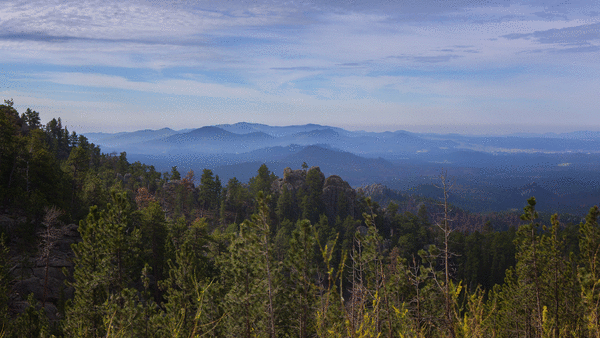
South Dakota is a state rich in natural beauty and resources. From the granite peaks of the Black Hills to windswept prairies that stretch for miles, there is nowhere quite like home for me.
Every fall, hunters arrive to pursue the Chinese Ring-Necked Pheasant, our state bird. In days past, a different kind of hunter also frequented our state: political strategists in pursuit of votes for storied South Dakota Democrats like George McGovern and Tom Daschle.
That era feels distant now. But it isn’t. As recently as 2010, Democrats held five of the Dakotas’ six Congressional seats. Today, we hold none.
It can be challenging to be a tiny blue dot in a ruby-red state that you love. I ran for state senate in 2024, the same year Donald Trump received a record vote share here. Though I connected with voters and outperformed the national ticket, I still lost. But my experience in a deep-red state gave me perspective on how Democrats can compete again in states like South Dakota.
Democrats’ recent electoral victories show that they can win by engaging voters on their own terms; the same is true in red states. Here are my thoughts on why many South Dakotans feel unrepresented by Democrats and what to do about it.
1. We are not just “flyover country”
First, Democrats must address the “flyover country” problem: the perception among many South Dakotans that coastal elites see them as unimportant. It's frustrating to hear Democrats described as “elitist” or “out of touch” because most local Democrats are down-to-Earth and familiar with our state’s problems. Still, there’s no denying Democrats have an image problem.
Red-state Democrats must combat that perception by advertising their local roots. National news about D.C. infighting and political sermons by Hollywood celebrities rarely resonate here. Our cultural touchstones are more likely found in South Dakota Magazine or by walking down Main Street during the Sturgis Motorcycle Rally.
South Dakotans want to feel respected and heard. To meet—and exceed—that expectation, we need to show our connection to these cultural touchstones.
2. Red-state voters are not a monolith
Second, Democrats must stop treating red-state Americans as a monolith. This view ignores vast cultural diversity. In South Dakota, for example, our large Native American population creates a distinct political dynamic.
To win, Democrats must see this diversity as an opportunity. By speaking to Native issues, rural economic anxieties, and small-town cultural pride, Democrats will find that “red state” doesn’t mean “lost cause.”
3. Meet red-state Americans where they are on crime and immigration
Third, we cannot dismiss concerns about crime and immigration as right-wing talking points: They are real issues for many voters. When Democrats ignore these fears, they cede the conversation to Republicans. Acknowledging these concerns is the first step to rebuilding trust. We must offer practical solutions for community safety and border security that uphold our values and the rule of law.
4. Focus on working- and middle-class economic priorities
Finally, Democrats must reclaim their status as the party of the working and middle classes.
The Democrats’ decline in the Dakotas reflects a national trend, culminating in the recent loss of Montana's last statewide-elected Democrat. These defeats occurred despite growing national diversity, which, on paper, should favor Democrats.
The problem is that the Democrats, once the champions of the working class, are now widely viewed as the party of corporate elites. Many red-state Americans see them as consumed with cultural battles rather than kitchen-table economic concerns.
I fell victim to this myself. In my race, I doubled down on abortion after a pro-choice amendment made the ballot. It didn't work. I failed to understand that a message centered on affordability would have been more effective. For example, many voters I spoke with cared deeply about expanding free school lunch programs. One said he’d rather see money go to that than the “$5 million for (Kristi) Noem’s ads” (referring to ads by our former governor “promoting” South Dakota jobs).
My experience reflects a larger challenge. To build a national coalition, the Democrats must prove their policies can help all Americans. Voters are hungry for someone who understands their lives and will deliver real solutions. That’s the kind of opening Democrats should seize.
Conclusion
I didn’t win, but I came away convinced that Democrats can compete here again. A small investment in passionate candidates can have an outsized impact in overlooked states like South Dakota. Don’t just fly over us: stop here, talk to us, and see we are worth fighting for.
____
Clay Hoffman is a South Dakota native who is passionate about improving his community and making South Dakota affordable for everyone. He ran for state senate in 2024, has prior experience in public service and the nonprofit sector, and currently works as a Development Director for the Boys & Girls Club of the Sioux Empire.
_____
©2026 The Fulcrum. Visit at thefulcrum.us. Distributed by Tribune Content Agency, LLC.













































Comments