Commentary: $1.5 trillion for the Pentagon is a recipe for waste and fraud
Published in Op Eds
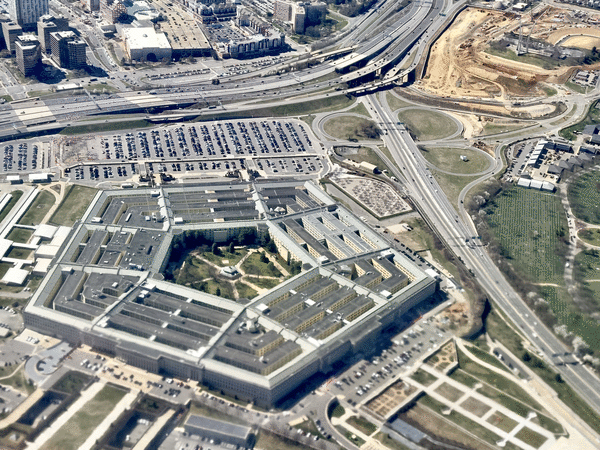
Less than three months ago we published "The Trillion Dollar War Machine," which chronicles and laments the enormous amount of money the U.S. was set to spend on “defense” this year – money that enriches special interests, but offers little real security to most Americans. Today, the federal government is preparing to double-down on this folly.
At a time when Americans are struggling to pay for housing, grocery prices are soaring, and healthcare is getting out of reach for more and more families, the federal government is poised to invest an additional $500 billion, not in these areas where Americans need help the most, but in the military industrial complex, which already receives more taxpayer dollars than ever before.
The president’s call recently for a $500 billion increase in Pentagon spending in a single year, if implemented, would be an invitation to unprecedented waste and fraud. It would do nothing to defend us, and everything to enrich weapons makers, their executives, and their shareholders at the expense of the rest of us.
The reasons are abundantly clear to anyone not on the take in this corrupt system. First of all, the U.S. military and the U.S. defense industry are in no position to use such a huge short-term infusion of funds effectively. There aren’t enough factories or skilled workers to build weapons that would consume that enormous sum. The $500 billion increase alone – part of a total Pentagon budget that would hit $1.5 trillion – is higher than the total military budget of any other nation, and more than what China, Russia, and Iran spend on their militaries, combined.
The last thing the Pentagon needs is more of our tax dollars, given that it has never passed an audit and safeguards against price gouging and the provision of shoddy systems are being dismantled. Secretary of Defense Pete Hegseth wants to cut personnel at the Pentagon’s independent testing office by 75%. A House response to this proposal suggested that slashing the office would increase the chances of “catastrophic failure” for one or more major weapons programs.
What the Pentagon–and every government bureaucracy–needs most of all is more spending discipline. That means it should stop throwing money at dysfunctional, outmoded or unnecessary weapons programs like the F-35 combat aircraft, $13 billion aircraft carriers, and a new generation of nuclear weapons. These systems alone consume tens of billions of dollars that could be used to address real needs in the U.S., like healthcare, housing, and child care.
Spending $1.5 trillion on the Pentagon will make it easier to pursue unnecessary, costly wars like the recent intervention in Venezuela, or whatever other new wars the administration’s bullying approach to foreign policy may spark. A strategy of restraint that puts diplomacy first and makes war a tool of last resort could save hundreds of billions of dollars in the next few years alone.
In a world that is more chaotic by the day – in part due to the policies of our current administration – we need a balanced set of tools for engaging with the rest of the world. That means an efficient, effective defense force; an experienced diplomatic corps backed by a president open to negotiations with potential adversaries; the ability to provide targeted economic assistance to nations in need; and a program of cooperation and cultural and educational exchanges with key nations.
Of the above tools of international engagement, only one –the military tool – is being wildly overfunded, while resources for the other tools are being radically reduced. The result will be a country unable to negotiate a stable peace and poised to embark on more forever wars that leave America less, not more, safe. The costs of this military first foreign policy – in lives, tax dollars and the global reputation of the United States – will be unacceptably high.
Forging a more effective foreign policy must begin by making more balanced investments in non-military versus military tools of foreign policy. A $1.5 trillion Pentagon budget will make the pursuit of a more balanced, effective foreign policy virtually impossible. The resulting, militarized approach to the world will alienate friend and foe alike, while doing nothing to improve the safety–let alone the livelihoods–of most Americans. It’s not too late to head off this colossal error in the making by speaking out forcefully against it.
____
William Hartung is a Senior Research Fellow in the Quincy Institute’s Democratizing Foreign Policy program, which is directed by Benjamin Freeman.
_____
©2026 Tribune Content Agency, LLC.




















































Comments