Noah Feldman: ICE isn't just breaking the law. It's trying to rewrite it
Published in Op Eds
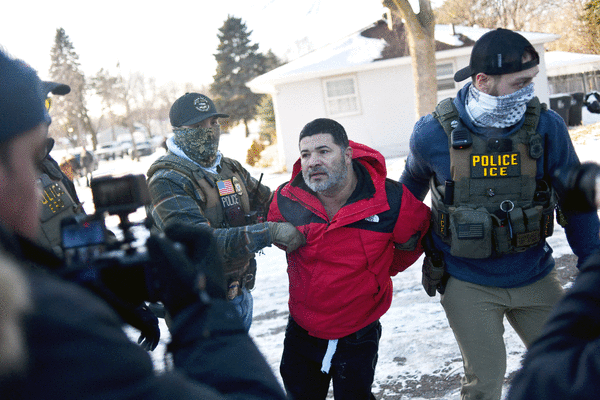
In an outrageous expansion of its authority, Immigration and Customs Enforcement is now authorizing its agents to arrest anyone they suspect of being undocumented, even if the officers don’t have a warrant and the person isn’t a flight risk.
The directive, contained in a memo obtained by the New York Times, reverses long-standing ICE policy and effectively renders the warrant requirement itself empty. Coming on the heels of another legally indefensible memo, which purported to allow ICE agents to enter the homes of suspected undocumented people without a judicial warrant, the new policy shows that ICE isn’t just exploiting legal loopholes to create massive sweeps. Instead, it reveals an agency actively attempting to change the legal landscape to turn itself into an all-powerful police force.
Federal law permits ICE to make warrantless arrests under only two circumstances. The first is when an agent sees someone actively crossing the border illegally. That scenario isn’t relevant to the current ICE sweeps, which take place in cities far from the border.
The second situation in which the law allows a warrantless arrest, the one addressed by the new memo, is if an ICE officer “has reason to believe” that someone is in the US without legal authority and “is likely to escape before a warrant can be obtained for his arrest.”
As even ICE has been forced to acknowledge, the phrase “reason to believe” in the statute means that the agent must have probable cause to think that the person is undocumented. That standard, borrowed from the context of criminal arrest, appears protective of individual rights.
But in a decision in its emergency docket last September, the Supreme Court disastrously eroded this protection by allowing street stops based merely on “reasonable suspicion” — a standard lower than probable cause. A solo opinion by Justice Brett Kavanaugh then extended reasonable suspicion to include factors like appearing Latino and speaking Spanish.
That brings us to the new memo, which addresses whether ICE agents can then arrest the person who has been stopped. Until now, it has been the long-standing practice of ICE to permit warrantless arrests only when the officers determined that the person stopped was a flight risk, meaning that they would be unlikely to show up for a court hearing. And until now, ICE has acknowledged that this rule was required by the statute’s demand that someone be “likely to escape” before they can be arrested without a warrant. In practice, that made it relatively unusual for ICE agents to carry out a warrantless arrest.
The new memo fundamentally transforms the meaning of the words “likely to escape.” It claims that a person who has been stopped is likely to escape if they are “unlikely to be located at the scene of the encounter” by the time an arrest warrant could be obtained. Since just about anyone would walk away from an ICE arrest if they could (at least under current circumstances), it follows from this interpretation that anyone stopped by ICE is “likely to escape” — and therefore may be subjected to warrantless arrest.
The memo says that ICE’s previous position about the meaning of the statute was “unreasoned” and “incorrect.” But it’s the new interpretation that is unreasoned and incorrect. According to ICE’s interpretation, there would be no reason to ever require the issuance of a warrant, given that ICE agents can, under the new theory, effectively arrest anyone who wouldn’t stick around once stopped. Put another way, ICE’s new interpretation turns the statute into a dead letter.
I realize all these legal technical details are a lot. So let me put it simply. Under the new memo, ICE agents can detain anyone they think might be undocumented, based on factors like ethnic appearance, language, and where you happen to be hanging out when they stop you. Once they’ve stopped you, they can claim to have probable cause that you’re undocumented (for example, because you don’t have proof of citizenship on you). Then the officers can simply arrest you, without a warrant.
The total package amounts to a sweeping authorization for ICE agents to roam the streets, grab just about anyone they want, arrest and detain them.
It’s not only that such proceedings are un-American. It’s that they are plainly unlawful under the legal regime that is supposed to apply. The warrant requirement for an ICE arrest, established by statute, is meant to function as a protection against exactly the kind of massive, non-specific sweeps ICE is now performing.
Similarly, the requirement of a judicial warrant before entering a home is a foundational safeguard of individual liberty.
The good news about ICE’s attempts to get around the law is that they will come before the courts. The courts should affirm that the statute means what it says: “likely to escape” means that ICE may not arrest a person without a warrant unless they are a flight risk. Judicial interpretation of federal law is a cornerstone of preserving the rule of law itself. ICE’s actions are terrifying, and meant to be, but the law remains one of the tools that can be used to resist a descent into a police state.
____
This column reflects the personal views of the author and does not necessarily reflect the opinion of the editorial board or Bloomberg LP and its owners.
Noah Feldman is a Bloomberg Opinion columnist. A professor of law at Harvard University, he is author, most recently, of “To Be a Jew Today: A New Guide to God, Israel, and the Jewish People."
©2026 Bloomberg L.P. Visit bloomberg.com/opinion. Distributed by Tribune Content Agency, LLC.





















































Comments