Lisa Jarvis: One year of RFK Jr. has left public health devastated
Published in Op Eds
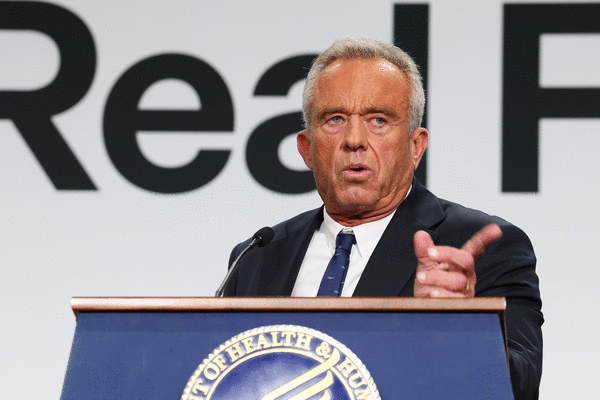
Robert F. Kennedy Jr. made a lot of promises on his way to becoming health secretary. He pledged to Make America Healthy Again, of course, and to restore trust in embattled health agencies. And he said he wouldn’t “take away anybody’s vaccines.”
In his first year in office, he’s already broken most of these promises.
The sweeping, chaotic changes he has made since he was sworn in last February have shaken medicine and science in the US to the core. That’s wreaking havoc on public health. Less than half of Americans have confidence in health agencies’ ability to make science-backed decisions, according to a new KFF survey.
Kennedy’s most high-profile moves have been around vaccines. Back in June, he fired the panel that advises the Centers for Disease Control and Prevention on vaccines and replaced them with skeptics and peddlers of misinformation. In a stunning move, he then fired CDC director Susan Monarez for refusing to get rid of career staffers and rubber-stamp his handpicked vaccine advisory panel’s recommendations. With her out of the way, the CDC went on to make alarming changes to the childhood vaccine schedule.
But that’s only start of the long-term damage wrought by Kennedy in his first year in charge of the Department of Health and Human Services. He also has dramatically reshaped the agencies under the HHS umbrella. New administrations routinely bring in fresh leadership to helm health agencies, but the exodus of talent under Kennedy’s watch is less common.
Scientific expertise from the top all the way down to bench scientists has been lost through both layoffs and a mass exodus of staff. An analysis by Science found that nearly 2,400 Ph.D.s had exited the three agencies combined last year, two to three times more than in 2024. And at the National Institutes of Health, the crown jewel of federal research, more than half of its 27 institutes currently lack directors.
The damage has extended to the vast academic research ecosystem the agency supports. After a year of ruthless grant terminations and subsequent reinstatements by the courts, researchers funded by the NIH and National Science Foundation had lost some $1.4 billion in funding, according to a recent review by Nature. Meanwhile, new grant awards from NIH to academic labs fell by some 24% in 2025, a pullback that could slow down medical discoveries in the US.
The FDA, valued by big pharma and consumers alike for its steady, reliable regulation, has instead been marked by chaos. Last year, five different people acted as director of the Center for Drug Evaluation and Research, the arm of the agency that oversees new drugs. Some of the departures came amid scrutiny of a new voucher program introduced by FDA director Marty Makary — an initiative that has seemed to be motivated more by political maneuvering than improving patients’ lives. Meanwhile, the head of the vaccines arm, Vinay Prasad, has made unilateral policy changes that could limit access to certain shots, while also chilling investment in the sector.
And then there’s the CDC. Beyond the vaccine upheaval, some of the agency’s core functions seem hobbled. Last month, an analysis in the Annals of Internal Medicine found that much of the data traditionally published by the agency has come out late or not at all. Meanwhile, the CDC has issued just a handful of health alerts in the past year, compared to the sometimes dozens it will put out in a typical year. The radio silence has left local health departments in the dark about threats lurking in their communities.
Now, the CDC is without a leader. HHS deputy secretary Jim O’Neill, who had been named interim director after Monarez was fired, was among several to be ousted last week. Given the last year’s tumult, it’s hard to believe anyone with scientific credibility would want the job — or that anyone picked by Kennedy could pass muster with the Senate.
The changes at CDC are starting to feel irreversible. That’s in no small part because Kennedy and other health officials have spent the year chipping away at the public’s already shaky confidence in the CDC’s expertise — and at the concept of expertise itself. Over the last year, Kennedy has repeatedly undermined public trust in the scientists and doctors who work for him. Nothing encapsulates that more than his refrain encouraging the public, and especially parents, to “do your own research.”
At the same time, other structures are falling into place to fill in the gaps left by this hobbled CDC. States and medical associations are forming their own public health groups intended to coordinate during outbreaks; share resources; and send out clear, evidence-based information and advice.
Those initially seemed like ad hoc alliances, meant to patch over a period of disruption. Yet as time goes on, it’s become clear they must develop into strong, sustainable alternatives — and perhaps one day evolve into federally funded entities that can support the needs and priorities of different regions.
The question is what comes next from Kennedy. He surely isn’t done with vaccines. Next in his sights is a remaking of the National Vaccine Injury Compensation Program, the fund that pays people who suffer from a rare side effect from a shot. When he got rid of half of the panel that determines compensation last month, it set off alarm bells: If he names members open to growing the list of covered injuries to include ones not backed by science — for example, autism — it could quickly bankrupt the fund and eventually prompt some companies to stop making shots.
Some might be encouraged by reports that Kennedy plans in this election year to shift his focus to a more politically popular topic: healthy food. Yet his actions so far leave little faith that he is interested in making evidence-based changes. His overhaul of the food pyramid has gotten mixed reviews for its overemphasis on red meat and saturated fat, for undoing previously concrete recommendations around alcohol consumption, and for the conflicts of interest of some of the advisers who helped craft it.
Even if Kennedy were able to make substantive progress towards improving Americans’ access to “real” food — and I sincerely hope he does — it can’t outweigh the damage he has done in a single year. His legacy ultimately will be measured by the senseless suffering his policies have wrought. The magnitude of that pain will unfortunately grow larger the longer he’s in office.
____
This column reflects the personal views of the author and does not necessarily reflect the opinion of the editorial board or Bloomberg LP and its owners.
Lisa Jarvis is a Bloomberg Opinion columnist covering biotech, health care and the pharmaceutical industry. Previously, she was executive editor of Chemical & Engineering News.
©2026 Bloomberg L.P. Visit bloomberg.com/opinion. Distributed by Tribune Content Agency, LLC.

















Comments