Commentary: How El Mencho's death in Mexico could make drug cartel violence worse
Published in Op Eds
There have been times throughout history when a single event is so significant that it snowballs into international news. Think of the fall of the Berlin Wall in 1989, the dissolution of the Soviet Union in 1991, the 9/11 terrorist attacks or the killing of Osama bin Laden a decade later.
For Mexico, the killing of drug lord Nemesio Rubén Oseguera Cervantes, otherwise known as El Mencho, in a Mexican security operation in the state of Jalisco last weekend was certainly one of those moments. The successful targeting of Mexico’s most violent and powerful narcotrafficker is arguably the country’s biggest tactical success since security forces recaptured the infamous Joaquín “El Chapo” Guzmán a decade ago.
Yet in a cruel twist of irony, Mencho’s demise could also make the problem of narcotrafficking even worse than it is today.
Mencho was the definition of a brutal criminal who took no mercy on his enemies. Like El Chapo before him, Mencho grew up poor in a rural area. He migrated to the United States in the 1980s, only to be arrested three times on drug charges, jailed in a California penitentiary for three years and deported back to Mexico in the early 1990s. Back in his home country, he joined the local police force, quickly hooked up with his brother-in-law Abigael González Valencia, who was a major player in the drug trade and rose up the ladder of the so-called Milenio Cartel. After the cartel’s leadership was decapitated by Mexican security forces, Mencho took matters into his own hands by creating a new faction that would come to be known as the Jalisco New Generation Cartel (CJNG). In a few short years, this criminal organization began to rival El Chapo’s Sinaloa Cartel, only to surpass it after Chapo’s former organization went to war against itself in 2024.
As one might expect, Mexican President Claudia Sheinbaum is in a happy mood these days. Not only is the country’s most dangerous criminal neutralized, but the daring operation helps bolster her case that Mexico is heeding President Donald Trump’s demands to act more aggressively against the country’s criminal networks. Sheinbaum has gone to great lengths to cater to the Trump administration’s expectations by green-lighting additional CIA air surveillance in cartel-infested regions, allowing a small detachment of U.S. military advisers into the country for exercises and sending more than 90 high-profile drug operatives to the United States for prosecution. One of those operatives was none other than Mencho’s brother. Cooperation between the U.S. and Mexico on counter-narcotics operations has also been beefed up; the White House confirmed that the United States assisted the Mexican army with intelligence during Mencho’s attempted capture.
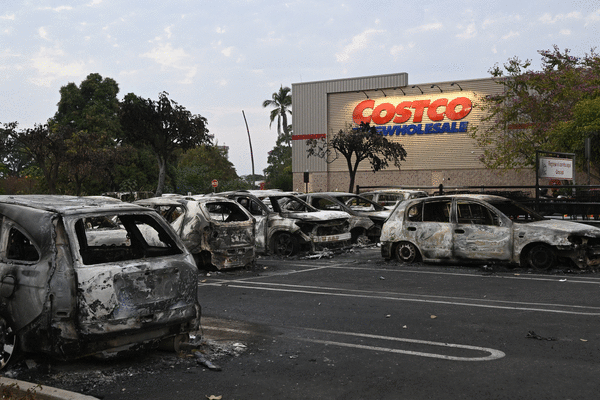
That’s all good news. Still, it’s hard to celebrate when news of Mencho’s death was eclipsed by the CJNG’s retaliation, which was fast, chaotic and deadly. Cartel gunmen essentially turned a significant chunk of Mexico into war zones, blocking highways with the remains of charred vehicles, torching convenience stores, forcing tourists in the picturesque city of Puerto Vallarta into lockdown and introducing some mayhem in Guadalajara, one of Mexico’s biggest cities. At least 25 Mexican soldiers were killed in the ensuing retaliation. The U.S. Embassy in Mexico City advised Americans in the country to shelter in place.
This isn’t the first time Mexico has taken a drug lord off the field, only to discover in short time that decapitating a cartel’s leadership doesn’t automatically translate into the organization’s collapse. And even if it were to, rival groups would seek to exploit the situation by filling the vacuum, cornering more of the lucrative drug trade and carving out their own empires. Therein lies the problem with a war-on-drugs mentality: While this approach can deliver headline-grabbing wins for governments and provide politicians with some positive gains in the polls, the sense of victory lasts for only a short while. Eventually, criminal organizations will adapt to protect their equities in a billion-dollar market, use ever greater levels of violence against the state and further fracture an already complicated cartel landscape.
One doesn’t need to look very far for an example. After one of El Chapo’s sons conspired to kidnap Ismael “El Mayo” Zambada, a top leader in the Sinaloa Cartel, in the summer of 2024, the entire organization descended into a civil war that continues to this day. With their leader detained, El Mayo’s sicarios, or hit men, declared war against supporters of Chapo’s sons in an attempt to exact vengeance for the treachery and strengthen their own position in the wider organization. The result has been a bloodbath in the state of Sinaloa, with thousands killed, thousands more missing and the violence reaching such heights that the Mexican government looks hopeless, if not hapless.
The moral of the story: When you cut off the head of the octopus, the tentacles go out of control.
It’s far too early to predict whether the CJNG will descend into civil war like its rival Sinaloa. Ordinarily, one of Mencho’s siblings or sons would take over to ensure a smooth transition, but all of them are locked up. If the Mexican government were smart, it would prepare for a situation in which Mencho’s lieutenants turn their guns on each other in a bid to become the new boss. In this scenario, the CJNG would fracture into smaller, warring factions, producing more obscene levels of bloodshed as potential replacements try to prove their mettle. This would be the exact opposite of what Sheinbaum and Mexico need right now, particularly when Trump continues to bring up the idea of deploying the U.S. military to do the job.
How the Mexican government navigates this tricky period may determine if the Mencho operation was a hopeful turning point or merely a momentary success.
_____
Daniel DePetris is a fellow at Defense Priorities and a foreign affairs columnist for the Chicago Tribune.
___
©2026 Chicago Tribune. Visit at chicagotribune.com. Distributed by Tribune Content Agency, LLC.











































Comments