Trudy Rubin: Beware the similarities between the wars in Iraq and Trump's Iran war
Published in Op Eds
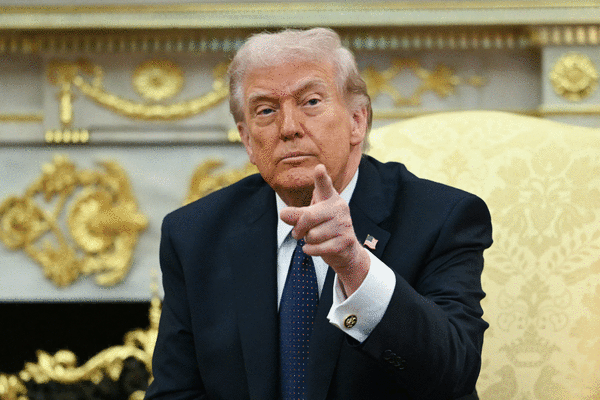
President Donald Trump and his administration insist their war of choice in Iran bears zero similarity to the bitter Iraq War the U.S. plunged into 23 years ago. I disagree.
Both wars were based on lies about imminent threats from nuclear weapons to justify wars of choice. In 2003, the intelligence on Saddam Hussein’s nuclear program was cherry picked and false. In 2025, Trump himself told Americans that Iran’s nuclear program had been “obliterated” by U.S. and Israeli airstrikes in June, and there is no evidence that Tehran is able to reconstitute the program — so there was no “imminent threat” to America.
The new White House line that Israeli pressure prompted Trump’s decision to bomb, has already been rejected by the president (although it may contain several kernels of truth).
In 2003 as today, the U.S. president had trouble clarifying the strategic goals of the war. Unlike George W. Bush, Trump denies he seeks “regime change” (after calling for it). But then as now, there was little to no preparation for “the day after” the war ends.
Such lack of vision — or ample self-delusion — propelled Americans to disaster in Iraq, even with some competent advisers in the White House. As Trump directs policy solo, based on whim and ill-informed whispers from Jared Kushner and Steve Witkoff, it’s hard to see a happy ending in Iran.
Yet, having covered the 1991 Gulf War and the 2003 Iraq War (in all its phases through 2017), what I find most tragic is the potential for ordinary Iranians to be harmed as badly by Trump as Iraqis were hurt by Bush’s war.
Few Iranians will mourn the demise of the cruel and murderous Ayatollah Khamenei or his cohorts, and a large segment of Iranians want the corrupt religious regime gone. But despite Trump’s treacly protestations of sympathy with the brave Iranian civilians whom he keeps urging to rise and overthrow the ayatollahs, all signs point to his willingness to abandon them if he needs a quick exit from his new war.
It is this aspect of Trump’s Iran war that hits me hardest in the gut, because I saw it happen before in Iraq.
In 1991, when I was covering the first Iraq War, President George H.W. Bush called for Iraqi Kurds and Shiites to revolt against Saddam Hussein (whose mainly Sunni followers controlled Iraq), as the United States pushed into southern Iraq from liberated Kuwait. They followed his call.
But Bush 41 chose not to continue on to Baghdad and depose the Iraqi regime, because his advisers warned this would set off an Iraqi civil war. Moreover, he left much of Hussein’s army intact, along with their attack helicopters. Around 10,000 Shiites were slaughtered; several hundred Kurds in Iraq’s north had to flee into the freezing mountains in winter, until the U.S. Air Force established a no-fly zone over Iraqi Kurdistan and they could return home.
In February 2003, I crossed from Iran into Iraqi Kurdistan to await the invasion of Iraq by Bush 43, who claimed he had to destroy the (non-existent) Iraqi nuclear program and bring democracy to the country. At the time, it was hard not to get swept up in the enthusiasm of Iraqi Kurds for the regime change the Americans were promising in Baghdad.
America’s regional allies, especially Israel, urged us to decapitate the Baghdad dictatorship — and White House hawks insisted “regime change” would quickly bring peace and democracy to the entire Mideast. So did exiled members of multiple Iraqi opposition groups, with whom I had been in contact since covering the 1991 Gulf War.
Bush disbanded Iraq’s military and fired much of its government. But he had no grasp of the complex ethnic and religious politics of Iraq, which engulfed U.S. forces and created an internal Iraq civil war between Shiite and Sunni Muslims.
Fast forward to Trump, who (at least for today) says his goal isn’t regime change. He insists he will not put boots on the ground and that the war will only last a few weeks.
Even though Iran’s 86-year-old supreme leader, Ayatollah Khamenei, was killed by an Israeli airstrike, along with around 40 other Iranian leaders, that’s not likely to end the regime, but more likely to produce a military-backed dictatorship. Both sides may need a breather in a few weeks as Iranian missiles, and U.S. interceptors run short.
But the president has already made clear he has little interest and no concrete plans for what should happen in Iran after the death of its religious leaders. Trump has upturned the famous doctrine that the late Secretary of State Colin Powell applied to 2003 Iraq, namely “If you break it, you own it.” The Trump Doctrine posits: “We break it, you own it. Goodbye and good luck.”
He has stressed that it is up to Iran’s people to rise up and take over their country, even though civilians are bereft of leaders, organization, guns or even internet connections (and Reza Pahlavi, the exiled son of the last Shah, who hasn’t stepped foot in Iran for decades, has no armed forces of his own).
Squeezed by the MAGA faithful, and partial to quick hits, Trump insists there will be no long-term U.S. involvement. This may avoid U.S. military casualties but will probably leave Iran in chaos, ruled by hard men who still retain weapons.
That’s because the strongest remaining military force in Iran is the hard-line Iranian Revolutionary Guard Corps (IRGC), which is deeply rooted throughout the country. Behind them are hundreds of thousands of Basij militiamen, who have proved ready to kill demonstrators.
Trump has told journalists he would like to model the Iran venture on the U.S. intervention in Venezuela, where the top leader, Nicolás Maduro, was kidnapped, and Trump then made a deal with his vice president. In Caracas, Trump eliminated a leader he disliked, but kept the previous regime, which in turn handed him control over Venezuelan oil.
Iran, however, could not be more different. Trump would like to see the IRGC, or one faction, make a deal to totally eliminate Iran’s nuclear weapons program and missile production. The president told journalists, apparently with regrets, that some potential new leaders had been killed in the bombing, and speculated that Iran’s future leader could be “as bad” as the last.
More likely, the IRGC will fight to the end to maintain power and won’t be dislodged without sending ground troops. It has proved willing to slaughter tens of thousands of civilians to keep power and would be willing to do so again.
I worry that Trump’s continued call for a civilian uprising to “take over” Iran only holds out the prospect that Iranian civilians will once again be slaughtered, even as Trump chooses to declare victory and send the fleet home when missile interceptors run short and his followers grow antsy. Israel may continue bombing, but that won’t help Iranian protesters.
In a further sign of how the administration may use and abuse Iranians, CNN reported that the CIA is arming Iranian Kurds to spark a wider uprising vs. the regime (even as Trump abandons Syrian Kurds, who helped U.S. forces fight ISIS 10 years ago, but now are of no more use to him). Would Trump then abandon Iran’s Kurds if he decided to ink a pact with some IRGC general whom he thought could become a flexible dictator of Iran?
For Trump, the Iran war is an exhibition of U.S. power, designed to enhance his imperial stature as the GOP faces dicey midterms and the Epstein hangover. For Iran’s people, Trump’s reality show is a life threatening matter. His “we break it, you fix it” doctrine could consign many of them to death.
___
©2026 The Philadelphia Inquirer, LLC. Visit at inquirer.com. Distributed by Tribune Content Agency, LLC.


















































Comments