Conor Sen: Health care can't be the only job in town. But it is
Published in Op Eds
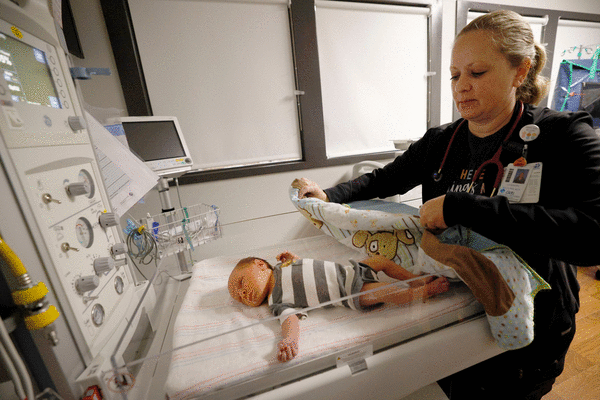
The two main drivers of U.S. economic growth right now — artificial intelligence and an aging population — are combining to make health care the most appealing career option for job seekers.
The sector bucked the hiring caution that infected so many other industries last year, becoming the biggest job creator. But what happens when health care openings start drying up, too?
The economy is unbalanced at the moment. Half of the 2.2% gain in inflation-adjusted gross domestic product in 2025 came from health care and two drivers of the AI economy, information processing equipment and software. Their combined contribution was a record outside of the pandemic bounce-back year of 2021.
This narrow growth profile is hard on workers, particularly when AI is seen more as a threat than a labor-market accelerant.
As investments in the technology have surged, worker confidence has cratered. Young people, especially, feel like the traditional paths to success are no longer available to them. Who’s to say that the job you land or hope to land won’t someday soon be displaced by a bot?
No sector is being transformed faster than software, where AI agents are taking on roles that young professionals may have filled. The technology industry is pouring hundreds of billions of dollars into building data centers and importing semiconductors from Taiwan and memory chips from South Korea, but doesn’t seem to require many more white-collar workers.
Instead, employment for early-career software developers declined nearly 20% from a 2022 peak, Stanford University researchers found in “Canaries in the Coal Mine? Six Facts About the Recent Effects of Artificial Intelligence.” There were also fewer opportunities for younger workers in areas such as marketing and sales. More broadly, the information, professional and business-services sectors shed some 173,000 jobs in 2025.
In contrast, health care is a labor-intensive industry that’s become more central to the economy as baby boomers retire; the number of people collecting Social Security swelled by more than 2 million last year alone. Plus, we can all hope to live longer thanks to advances in medical technology.
The Stanford paper showed employment for young professionals grew faster than for older workers in roles including nursing aides, psychiatric aides and home-health aides. Overall, health care added nearly 400,000 jobs in 2025, slower than the heady pace of 2023 and 2024, but still faster than just about any period in the past 35 years. (U.S. payrolls grew by 181,000 last year.)
Labor market anxiety was on full display last month when markets dropped on a Citrini Research report outlining an extreme scenario where AI disrupted every manner of knowledge jobs faster than the economy and policymakers could manage the transition. It didn’t help that Jack Dorsey’s Block Inc. then announced it was laying off nearly half its employees in a pivot to AI.
Such predictions of doom go too far. A more sober analysis from Goldman Sachs Group Inc. estimates that AI could potentially automate 25% of all work hours, displacing 6% to 7% of jobs over a decade. AI will also create jobs, though there’s considerable uncertainty around where the new opportunities will lie.
Perhaps robots will one day replace doctors and surgeons, nurses and other caregivers, too, but that kind of disruption seems further away for health care than many other industries.
A bigger threat for now is that health care hiring just naturally slows. Last year’s trend was driven in part by the industry playing catch up on staffing after struggling to hire during the job boom of 2021 and 2022.
Health-care employment lagged through some combination of not being seen as attractive and because sectors like technology recruited aggressively. That dynamic flipped in 2025 when most industries weren’t in a hiring mood, but health care employers still had help-wanted signs out.
Job openings in health care and social assistance are currently a touch above pre-COVID levels, but they have been falling steadily since a 2022 peak. If the labor market this year resembles last year’s, health care would again account for most of the job growth in the country and employers should start to get pickier.
What sectors stand ready to pick up the slack? The most promising should be the white-collar grouping of professional and business services employment, which has been showing signs of improvement after three years of job shedding. There’s hope that employers will feel better about the future following last year’s business-friendly tax bill.
But a meaningful pickup in 2026 seems unlikely given the uncertainties that abound, including AI. Corporate executives are very much in the mood to do more with less — AI was brought up by executives at more than half of S&P 500 companies this earnings season with respect to productivity and efficiency, a Goldman analysis found. For now, it’s still health care to the rescue of a weak and uncertain labor market.
_____
This column reflects the personal views of the author and does not necessarily reflect the opinion of the editorial board or Bloomberg LP and its owners.
Conor Sen is a Bloomberg Opinion columnist. He is founder of Peachtree Creek Investments.
_____
©2026 Bloomberg L.P. Visit bloomberg.com/opinion. Distributed by Tribune Content Agency, LLC.





















































Comments