Commentary: Hanging the Pride flag at Stonewall Inn matters. Symbols give a voice to the past
Published in Op Eds
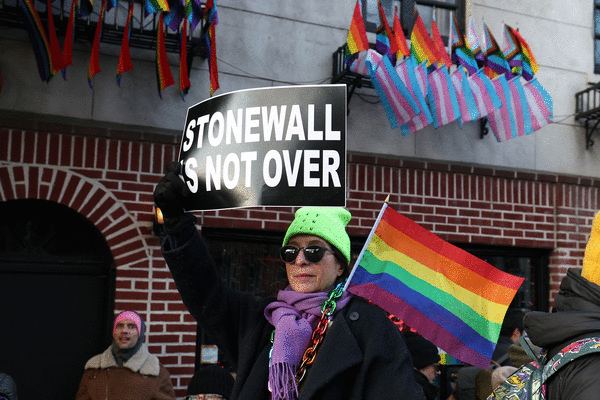
It was early on June 28, 1969 — more than an hour after midnight, usually a quiet time everywhere except New York, where the hustle never stops, especially in Greenwich Village. It was two years after peace and brotherhood gave birth to an epic Summer of Love, and however brief that euphoria was for America, it undeniably was a significant uplift.
The scene and mood on Christopher Street that late June night, however, were more like those of war: windows shattered and people, cuffed, groaning and bleeding on the curb. Patrol lights flashed as New York City police officers arrived in droves at the Stonewall Inn on the first of several nights of intense riots, which later gave birth to a symbol of resistance known worldwide: the Pride flag.
Today, the Pride flag is flying again near Stonewall, which became a national monument in 2016, after the flag was removed following a directive from the administration of President Donald Trump; this government action placed a community and its history at risk and ignited consternation.
The rehanging of the flag, also an emblem of resistance, is a reclamation of important history as well as identity. We are reminded that the past actually has voice — when we who are alive recognize it, which is possible through the symbols that represent the past and the mediums that preserve it.
Every day, my fellow Chicagoans and I interact with our city’s important symbols. In fact, I work in one: the Fine Arts Building. As a performer and general manager of the Studebaker Theater, I often examine my responsibility to history — my duty to preserve it and enable artists there to translate stories to Chicago audiences.
Standing up to defend these symbols can feel precarious when many people find it easier to retreat. Buildings, books — and even entire genres, such as opera — are the precious encyclopedias through which we peer into “once upon a time” and understand how today came to be. In a strident, sweeping effort, the Trump administration continues to lay siege to important American symbols in an effort to reframe our connection to history and distort future understanding.
Symbols function best when they remind us where we come from and suggest to us how to move forward. They are omnipresent in arts and culture: In addition to tradition and history, the DNA of the arts has been drawn from symbols that have instilled in our consciousness unshakeable ideas. It’s not Wolfgang Amadeus Mozart’s magic tuba for a reason. To divorce symbols from the context of their unique history is like asking a grape to ripen without a vine.
The past can’t speak if it doesn’t have a voice, which is why symbols are so important. We can’t allow them to be erased easily, so that the people and the history they represent don’t fade.
I have to remember that I am a guardian of symbols just as the people safeguarding Stonewall are right now. My city, Chicago, with art at its heart, makes it easy to be reminded. Even so, extinction of the expressions of our past, of our symbols, is always possible.
We must not forget that our power lies in our abilities to recall and retell; by combining those abilities, the sum is a particular and fortified kryptonite that repels oblivion. Symbols have an inexorable way of lingering in the collective mind and identity of the community. In spite of wars, chaos on a summer night and even an executive order, our symbols persist.
Since we are the voice of everything that came and spoke before us, some important part of our duty demands that we protect the important symbols of our past, especially today and especially right now.
____
Travis Whitlock is general manager of the Studebaker Theater in Chicago’s historic Fine Arts Building, an internet personality and an opera singer.
___
©2026 Chicago Tribune. Visit at chicagotribune.com. Distributed by Tribune Content Agency, LLC.












































Comments