Editorial: What the Artemis II mission means for humanity
Published in Op Eds
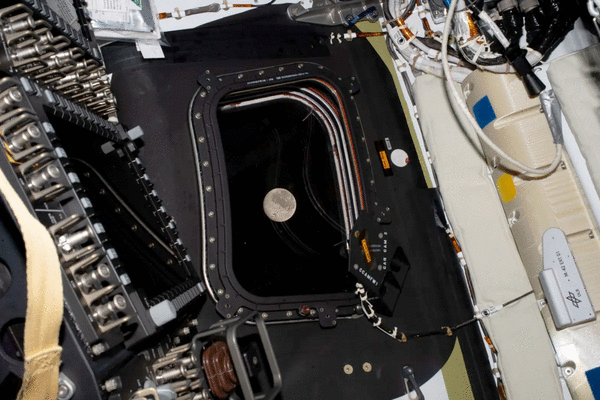
The 10-day Artemis II mission represents a defining moment in modern exploration. Four astronauts on Monday went further into space than any crew in history as they looped around the moon. It is a daring yet disciplined mission, one that signals not just ambition, but preparation for a sustained human presence beyond Earth.
Moments like this command global attention. When Apollo 11 touched the lunar surface, more than 650 million people watched worldwide, an almost unimaginable number at the time. Artemis II, in a fragmented digital age, still drew millions of concurrent viewers across platforms, not including countless watch gatherings in homes, classrooms and public spaces. The fascination endures because space speaks to something deeply human: the desire to explore, to understand and to reach beyond perceived limits.
Yet space exploration is not merely symbolic. Its value is practical, measurable and woven into daily life. The technologies developed for missions like Artemis have quietly reshaped the modern world. Memory foam, originally designed to improve crash protection for NASA astronauts, now supports millions in their homes. The camera sensors in our smartphones trace their evolution to efforts to miniaturize imaging systems for spacecraft. Scratch-resistant coatings used in eyewear and optics were refined to protect instruments in the harsh conditions of space.
Even the cordless tools we take for granted stem from innovations tied to lunar exploration, where mobility and battery efficiency were essential. Advances in spacecraft safety contributed to improved smoke detection technologies. And while NASA did not invent freeze-dried food or baby formula, space research has enhanced food preservation, nutritional science and additives used in infant care.
Perhaps the most profound contributions come in medicine. In microgravity, the human body behaves differently — cells grow, fluids shift and biological processes unfold in ways impossible to replicate on Earth. This unique environment has accelerated breakthroughs in cancer research, improving how drugs are delivered and how tumors are modeled. It has deepened understanding of Alzheimer’s disease and advanced methods to prevent muscle and bone loss conditions that affect millions.
Space, then, is not distant from our lives. It is intimately connected to them.
As Artemis II completes its journey, it does more than orbit the moon. It lays the foundation for what comes next: a permanent lunar presence, deeper exploration and new frontiers of knowledge. The benefits will not be abstract; they will be felt in our homes, our hospitals and our daily lives.
The mission holds special significance for Marylanders, too, who watched Cockeysville native Reid Wiseman lead his crew around the moon as mission commander. And they saw evidence of how great endeavors can bring us together, as the Artemis II crew, through tears, requested a lunar crater be named for Wiseman’s late wife, Carroll Wiseman.
In the end, exploration is not about escape. It is about return, bringing back knowledge, innovation and a clearer understanding of our place in the universe. And in the process, the brave astronauts aboard the Orion spacecraft remind us of our shared humanity and how our greatest moments come when we work together.
_____
©2026 The Baltimore Sun. Visit at baltimoresun.com. Distributed by Tribune Content Agency, LLC.





















































Comments