Gun violence rising in the Caribbean, new report finds. Gangs now an 'existential threat'
Published in Political News
To visitors, the Caribbean is a post card of white sand, sun-soaked beaches and tranquility. But millions who call the region home are confronting a much harsher and grimmer reality: the rise of lethal violence.
A new report released on Tuesday finds that firearm-related violence make up 86% of killings in countries that are part of the Caribbean community regional bloc known as CARICOM. And most of those murders are being committed by young men, many of whom are in gangs.
The report, “Pathway to Policy: Firearms Trafficking and Public Health in the Caribbean,” details other alarming trends, from the growing role of gangs to an uptick in gun attacks spilling directly into hospital emergency rooms.
“In several cases, shootings have occurred in hospital emergency settings … as a direct spillover from ongoing firearm-related altercations,” the report said. “According to officials and doctors, hospitals have become the site of shootings as assailants attempt to complete attacks on injured victims.”
The report notes that there is a spillover into the public health sector when hospitals, as has been the case in the last two years, have to go into lockdown mode because assailants have stormed their premises or a shooting has occurred nearby. That violence also is placing a substantial financial toll on national economies while straining healthcare systems. The estimated productivity losses in Jamaica from fatal and non-fatal injuries in 2024 were estimated to be $135 million, while for The Bahamas, it amounted to $72 million.
“Direct medical costs for firearm violence exceeded both per capita healthcare expenditure and direct medical costs for the treatment of injuries due to other weapons,” the report said.
Across the region, officials attribute much of the violence to the surging power of street gangs, many of them composed of increasingly younger members, including children. While Haiti, for example, remains an outlier with its extreme case of gang-related violence, the report’s authors note that law enforcement assessments show that gang activity accounted for 40% of homicides in Trinidad and Tobago between 2019 and 2024, 70% in Jamaica in 2022, and roughly one-third in Belize last year.
The report’s author notes that gang membership varies throughout the region, from fewer than 20 in St Vincent and the Grenadines and the Turks and Caicos Islands to hundreds in Jamaica and Trinidad and Tobago, and thousands in Haiti where they have formed powerful alliances to terrorize the population.
Some states “report that gang violence accounts for 33 to 70% of all homicides,” the report said. “The decreasing age of perpetrators of firearm-related violence in parts of the region further underscores this troubling trend.”
Leaders in the region frequently attribute the surge of firearm violence to transnational organized crime, gang activity, and illicit firearms trafficking,” the report said
During a meeting of CARICOM leaders earlier this year, Jamaican Prime Minister Andrew Holness warned gangs had become “an existential threat.” He called for greater regional and international cooperation, such as intelligence and resource sharing, to tackle the “grave” gang problem.
“Obviously, the ultimate case would be with the situation in Haiti,” he said. “But we also see gangs acting in ways and committing acts that can only be described as acts of terror. And therefore, I have called in Jamaica, and I’m making the call now at this CARICOM platform, that there needs to be a global war on gangs in the same way that there is a global war on terror.”
“If the gangs are allowed free rein, they will challenge the effectiveness and undermine states, which we are seeing happening not just in the region,” Holness added.
In looking at the rise of firearm-related violence in the Caribbean, the report also looks at the dynamics of illicit firearms trafficking, and the heavy public health and economic toll caused by gun violence.
The report was a collaborative effort by CARICOM, the 15-country regional bloc made up of mostly English-speaking nations along with French-speaking Haiti and Dutch-speaking Suriname; Trinidad-based Implementation Agency for Crime & Security, IMPACS; the Caribbean Public Health Agency, CARPHA; the George Alleyne Chronic Disease Research Centre (GA-CDRC) at the University of the West Indies, Cave Hill; and the Small Arms Survey.
Though the assessment focuses primarily, but not exclusively, on the 15 CARICOM member states and six associate members, the research team also included publicly available data on Cuba, the Dominican Republic, the French and Dutch territories and the U.S. Virgin Islands.
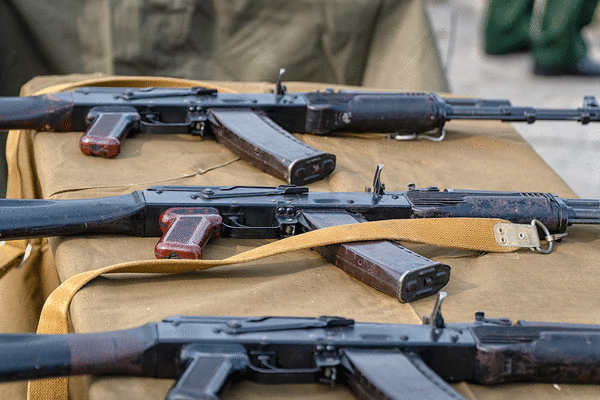
Multiple countries are struggling to control firearm related violence, which a number of Caribbean leaders describe as a public health threat. Another troubling concern raised in the report is the procurement of weapons. Handguns, or pistols, continue to dominate the illicit supply of firearms into the region, but AR- and AK-pattern rifles and trafficking in large-capacity magazines are also seeing a “modest rise.” Most seized shipments of these items at U.S. ports were intended for the Dominican Republic, Haiti and Trinidad and Tobago.
“Seizure and trace data confirms that maritime consignments from the United States are a primary vector for illicit trafficking, with procurement clustered in small areas of southern coastal states—notably Florida,” the report said.
But violence is not the same across the region. While Haiti is an outlier with its deteriorating security situation contributing to the high proportion of firearm use in homicides, Belize and Jamaica, for instance, have seen their homicides rates drops substantially in recent year.
Meanwhile, a small island like the Turks and Caicos, while recently seeing a downward trend in violence, according to its police, has shown a troubling trend. In once instance, police recently identified 32 homicide cases that involved firearms used by multiple people, with some firearms linked to up to seven homicides.
“This pattern points to frequent resale or rental practices and the ongoing sharing of firearms among a single criminal group,” the report found..
The report’s authors offer a number of policy recommendations on both a national and regional level. They include intensifying joint counter trafficking operations including with French, Dutch, U.S., and Dominican authorities; creating a Regional Multisectoral Commission to unify health, security, and social sectors and strong diplomatic engagement with the United States to curb trafficking.
They also call for developing regional hospital security toolkits and trauma-preparedness systems, and a scale up of community violence prevention for youth.
©2025 Miami Herald. Visit at miamiherald.com. Distributed by Tribune Content Agency, LLC.






















































Comments