Democrats tee off on possible Treasury corporate tax move
Published in Political News
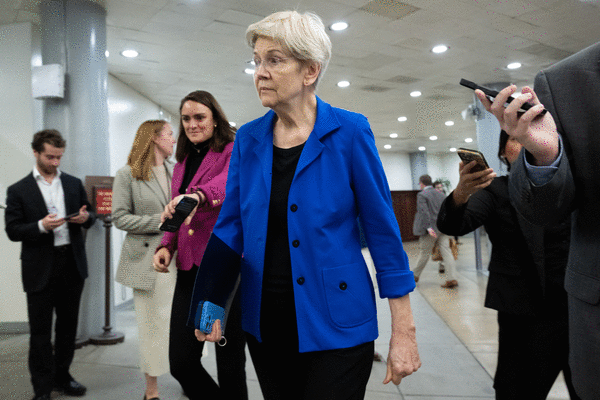
WASHINGTON — A group of Democrats in both chambers, led by Sen. Elizabeth Warren of Massachusetts and Rep. Donald S. Beyer Jr. of Virginia, is leading opposition to a potential regulatory carve-out from a new minimum tax on corporate profits that critics say could generate an unjustified windfall for big companies.
The Treasury Department and IRS are weighing a proposal from mega corporations such as Amazon, Microsoft and Ford Motor Co. that would address what they say is an unwelcome, unintended consequence of interactions among three major tax laws dating back to 2017.
If the regulatory boon is granted, these and other companies could get big refunds for research and development spending prior to 2025, which the Democratic critics say would drain the U.S. Treasury for little reason other than to reward donors.
“Retroactive [research and experimentation] expensing is already an indefensible policy because it is essentially a tax break for research that has already happened — and therefore a giveaway that cannot incentivize economic activity,” Warren, Beyer and seven other Democrats wrote Wednesday in a letter to Treasury Secretary Scott Bessent and Kenneth Kies, Treasury assistant secretary for tax policy.
The letter from Warren and others, shared with CQ Roll Call, points to estimates from the Joint Committee on Taxation that next year beneficiary companies could receive $67 billion worth of tax deductions. They cited a separate estimate from the left-leaning Institute for Taxation and Economic Policy that Amazon alone could receive nearly $23 billion.
The tax breaks would be offset in large part in later years, the JCT said, as companies would no longer be able to claim those accelerated deductions in the future as they would in the absence of the policy change.
Eight-year saga
The corporate lobbying from groups including the National Foreign Trade Council and R&D Coalition comes after the latest tax reconciliation package was enacted this summer under GOP control of the White House and Congress. That law marked the culmination of a research tax deduction saga going back to President Donald Trump’s first term.
The 2017 tax overhaul package included a provision requiring companies to start spreading their research expense deductions over five years, rather than claiming them all up front. Companies immediately started lobbying to reverse this, and particularly once the provision kicked in at the start of 2022.
Later that year, Democrats in charge of both chambers of Congress and the White House enacted a budget reconciliation package containing a 15% minimum tax on large corporations with “adjusted financial statement income” — income reported to shareholders, with certain allowable reductions — exceeding $1 billion for three consecutive years.
Under this provision, corporations would have to pay the difference between their normal tax liability with a standard 21% tax rate — reduced from 35% in the 2017 law — and the new 15% minimum tax. Companies could lower their minimum tax base through the use of typical deductions and tax credits, including for depreciation and R&D.
This new “corporate alternative minimum tax” took effect at the start of 2023.
Fast forward to the new, GOP tax package enacted this summer: Companies finally got their wish when Republicans restored full, upfront R&D deductions rather than continuing to force them to spread the deductions over five years. For prior research investments made during the 2022 through 2024 period, the law enabled businesses to claim deferred deductions this year or across 2025 and 2026.
However, that acceleration, when combined with full research expensing for 2025, means affected companies’ financial statement income could far exceed their taxable income, making them subject to a bigger hit from the corporate minimum tax.
Industry, think tanks weigh in
Companies are pushing for relief from the Treasury Department in the form of more favorable rules that allow them to exclude the R&D expenditures when calculating their adjusted financial statement income.
The Bipartisan Policy Center, a think tank, also supports the change. Andrew Lautz, the group’s director of tax policy, wrote in October that restoring full research deductions has been a bipartisan goal for years and that the 2025 law provision created “mismatches” with the corporate minimum tax that could “undermine” the new law’s benefits.
And the Trump administration has previously been open to easing up on the tax: The Treasury Department in September said it would soften a rule regarding the way cryptocurrency holdings count toward the minimum tax. The administration and GOP Congress have also implemented exemptions from the tax for utilities, insurance, shipping and oil and gas interests.
Critiques of the latest industry gambit have come from across the ideological spectrum, however. Kyle Pomerleau, a senior fellow at the conservative American Enterprise Institute, argued in an October article that the R&D tax hit is no unintended glitch.
“Contrary to claims by BPC and other business groups, there is little evidence that this interaction was unintended,” Pomerleau wrote. “Intent aside, there is little economic justification for Treasury action. … Changes to the treatment of these deductions would have no impact on future investment decisions.”
In their letter, dated Wednesday, the Democratic lawmakers pressed Treasury for answers by Dec. 17 on several questions including on what potential regulatory changes are being considered related to the provisions, the agency’s views on the corporate minimum tax and the number of corporations that would see lower tax liability under an R&D carve-out.
“Billionaire corporations keep lobbying Donald Trump to undermine the corporate minimum tax because it’s an effective backstop to make them pay their fair share,” Warren said in a statement. “Now, they’re trying to score yet another giveaway from Trump — this time, for research they’ve already done. The last thing American families need is a tax code rigged even more for billionaires and billionaire corporations.”
©2025 CQ-Roll Call, Inc., All Rights Reserved. Visit cqrollcall.com. Distributed by Tribune Content Agency, LLC.




















































Comments