Firefighting plan that tripped up spending package back on track
Published in Political News
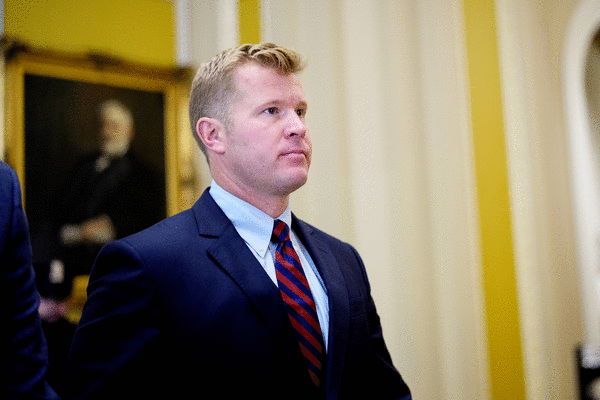
WASHINGTON — A dispute over a Trump administration plan to consolidate federal firefighting operations may be close to resolution, in a sign of modest progress toward Senate passage of a major fiscal 2026 spending package.
Sen. Tim Sheehy, R-Mont., said Thursday he was prepared to release his hold on the Interior-Environment bill, a prime candidate for the “minibus” spending package, after cutting a deal to remove language that threatened to delay, if not derail, the firefighting reorganization.
Sheehy, a former firefighting pilot and founder of an aerial firefighting and aerospace services company, is a key backer of the plan and rejected any effort to delay it.
“But we’ve cleared that language, so we should be good now,” he said.
The dispute was just one of several obstacles blocking Senate Majority Leader John Thune’s effort to win unanimous consent for combining as many as five annual spending bills into a package that he had hoped to bring to the floor this week.
While Sheehy’s hold may now be resolved, it also serves as a case study in how the most arcane policy dispute can tie up work on long-delayed appropriations for the fiscal year that began Oct. 1.
The administration announced plans in September to create a U.S. Wildland Fire Service, consolidating operations currently split between the Interior and Agriculture departments, following up on an executive order President Donald Trump issued in June.
The plan was designed “to modernize wildfire response systems, streamline federal wildfire capabilities, and strengthen their effectiveness,” Agriculture Secretary Brooke Rollins said in a statement at the time.
The eventual Interior-USDA plan released in September stopped short, for now, of consolidating wildland firefighting operations in one new agency housed within Interior, as Trump’s executive order called for.
But it proposes “unification” of firefighting operations at Interior under a new Wildland Fire Service. It also lays out a plan for “strategic alignment” with the U.S. Forest Service, which is part of USDA, while awaiting “full unification” with the Forest Service’s fire management operations.
Among the proposals: creation of a joint federal firefighting aircraft service, which could benefit companies like Bridger Aerospace, the Belgrade, Mont.-based company Sheehy founded after leaving active duty as a Navy SEAL.
Bipartisan backing
Sheehy has led the charge on Capitol Hill for unifying the agencies’ firefighting roles since the freshman took office at the beginning of this year. One of the first bills he sponsored was a bipartisan effort with Sen. Alex Padilla, D-Calif., to consolidate and streamline federal firefighting operations. That bill, introduced Feb. 6, awaits action by the Senate Agriculture Committee.
Coming off devastating wildfires in Los Angeles County in January, Padilla said the measure would streamline responses to similar disasters in the future.
“When catastrophic wildfires break out on federal lands, we can’t afford to waste time or resources overcoming communication and coordination barriers,” he said in a statement upon introducing the bill with Sheehy.
Trump’s budget request, submitted in May, proposed consolidating the firefighting agencies. His executive order the next month — citing the L.A. fires as an impetus to move quickly — gave USDA and Interior 90 days to figure out a consolidation plan “to the maximum degree practicable and consistent with applicable law.”
Concerns emerge
But the notion of upending the Forest Service and potentially disrupting firefighting operations led to swift blowback from former agency officials, conservation groups and more. Appropriators in both chambers, Republicans included, expressed hesitation to carry out such a sweeping reorganization.
Fiscal 2026 Interior-Environment spending bills, which fund the Forest Service as well, advanced in both chambers in July with language seeking to pump the brakes on any consolidation plan without further study.
House appropriators left out the reorganization plan from their version of the bill. And the committee report on the measure called on the nonpartisan Government Accountability Office to report back within 180 days on the administration plan and any “identified deficiencies.”
The Senate bill went further. It included a provision that would block any funds either in this bill or appropriated previously from being used “to transfer any functions, personnel, or resources from the United States Forest Service to the Department of the Interior for the purposes of establishing a U.S. Wildland Fire Service within the Department of the Interior.”
Senate appropriators also called for a report and briefings on the potential impact of such a move in an accompanying committee report.
Sheehy said the bill language would have prohibited “the combination of the multiple firefighting agencies that we have across the federal government into one singular agency — which is what we have advocated for on a bipartisan basis.”
Other holds linger
While Sheehy’s hold on the spending package may be lifted, Thune continued to negotiate with several other Republicans who have their own holds as they push for various causes, including a concern from some conservatives that spending levels are too high.
Thune, R-S.D., told reporters Thursday that negotiators were still working “through the concerns that our members have,” but added he’s hopeful they “can land something soon.”
“A lot of conversations going on around that, but we just need to — we’ve got to get on the package of bills,” Thune said.
Thune wants to add some combination of the Commerce-Justice-Science, Interior-Environment, Labor-HHS-Education and Transportation-HUD bills to the Defense bill in a package he could bring to the floor in coming days.
But he was unable to bring up a package this week as negotiations continued, leaving two weeks before the year-end holiday recess. Lawmakers face a Jan. 30 deadline for passing appropriations before current stopgap funding runs out.
--------
—Aidan Quigley and Jacob Fulton contributed to this report.
©2025 CQ-Roll Call, Inc., All Rights Reserved. Visit cqrollcall.com. Distributed by Tribune Content Agency, LLC.












































Comments