Crowded race to succeed Eleanor Holmes Norton as DC delegate includes 2 of her former staffers
Published in Political News
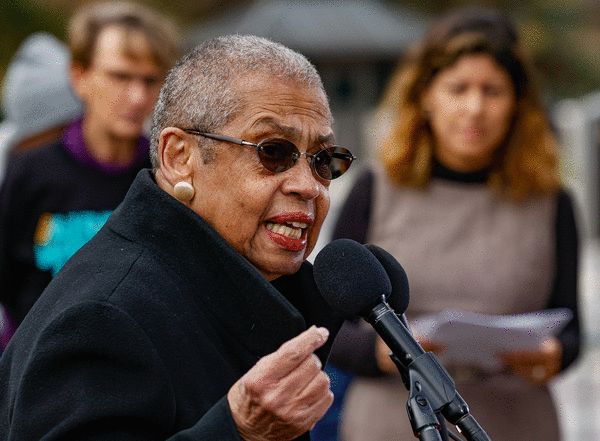
WASHINGTON — As they run for the same seat in Congress, Robert White and Trent Holbrook know all too well the power of a vote.
Why? They’ve lived it as former staffers to Democrat Eleanor Holmes Norton, the District of Columbia’s nonvoting delegate — a role that lacks a final say on the House floor.
“These are not normal times. We cannot afford to have a novice who will take years to understand Congress and the delegate seat,” White said earlier this month.
White worked for Norton for five years and is now an at-large member of the D.C. Council, leaving her office in 2013. Holbrook staffed Norton for eight years and left at the beginning of January to launch his campaign.
Both were willing to challenge their onetime boss, getting in the race even before she publicly signaled she was getting out. The 88-year-old Norton initially said she would run for reelection but filed paperwork to end her campaign over the weekend.
On Tuesday, Norton made it official, saying in a statement that she had “raised hell” in Congress but would retire at the end of the term “with fire in my soul and the facts on my side.”
As a growing number of Democratic primary candidates look to stand out from the pack, they are weighing how closely to tie themselves to Norton, who has long been revered in local circles but recently faced a flood of criticism for staying in office as her fitness seemed to decline.
White, for one, is playing up his experience, saying he wants to “carry forward the torch.”
“Largely due to her mentorship, I am ready to serve on day one,” he posted on social media after news broke that she was dropping her reelection bid. “I witnessed firsthand how she wielded a seat without a vote to deliver meaningful results for D.C. residents.”
Holbrook issued a statement saying he had stood “shoulder to shoulder with the trailblazing congresswoman.” Earlier in January, he positioned himself as a successor, not a challenger, saying, “I don’t see myself as running against Congresswoman Norton.”
“I think it’s important for D.C. voters to decide who can best carry on her important legacy,” he said at the time.
Realism and real estate
The June 16 primary is shaping up to be a crucial one for the nation’s capital. With both Norton and Mayor Muriel Bowser bowing out of their posts, multiple open council seats on the ballot and the implementation of ranked-choice voting, voters in deep-blue D.C. will have no shortage of choices to make.
It comes at a tense moment, after President Donald Trump deployed more than 2,500 National Guard troops in the District against the wishes of local leaders. In Congress, Republicans have sought to tighten federal control over local matters, and Rep. Andy Ogles, R-Tenn., and Sen. Mike Lee, R-Utah, say they want to repeal home rule altogether.
“Trump is treating the District like a colonial possession he can rule as a dictator,” veteran Democratic strategist Donna Brazile wrote in a Washington Post op-ed last year. Brazile publicly urged her onetime boss and mentor to retire, calling Norton “no longer the dynamo she once was.”
Other hopefuls vying for the delegate seat include D.C. Council member Brooke Pinto, former Democratic National Committee and Justice Department official Kinney Zalesne and local Ward 3 Democratic Chair Deirdre Brown.
Some are eager to see a firebrand in the role who can go toe to toe with Trump. But realistic goals matter too, according to White. The former legislative counsel recalled sitting down with fellow staffers and Norton in 2011 to strategize on clearing the way for a mixed-use redevelopment of the Southwest Waterfront.
“We believed that even in a Republican-controlled Congress, we could get three major pieces of legislation done to allow the development at the Wharf in D.C. to proceed,” White said. “And we did indeed get that done.”
Land is a key pain point in the city, where federal and local jurisdictions can overlap or collide.
“Our economy locally is very much supported by federal land transfers, like Navy Yard, the Wharf, Hill East,” said White, who was elected to the D.C. Council in 2016 and at one point unsuccessfully challenged Bowser for mayor. “All of these are huge development projects that have created countless jobs, revenue, housing, business opportunities for D.C., but these come through the delegate seat. So it is important that the person who goes into that seat in such a treacherous time, on Day One, knows what and where the power of that seat is, so that we don’t lose it.”
He also points to influence behind the scenes that can be difficult to measure. Recent Democratic presidents heeded the delegate, much as they would a senator, when nominating federal judges and the U.S. attorney for the District.
Some of that would be unfamiliar to a Hill outsider, White said.
“There’s no playbook. It’s not in statute. And if you don’t know, you don’t know,” he said.
‘I will not yield’
It’s hard to overstate how fully Norton has shaped the delegate’s role. The longtime civil rights advocate has served in Congress since 1991 and was just the second person in the modern era to hold the job, following Walter Fauntroy.
While she didn’t achieve her goal of securing statehood and full voting representation for the roughly 700,000 residents of D.C., she has touted progress over time, saying it was “within reach” when Democrats controlled the House, Senate and White House.
Her former staffers were along for some of that journey.
Holbrook said when the House passed a D.C. statehood bill in June 2020, and then again in April 2021, he helped shore up support.
“The bill had been voted on only one time in American history, back in 1993, and it failed 2-to-1. And I worked to make it a national issue, the national issue that it deserves to be by getting over 100 national organizations to endorse the bill,” said Holbrook, who rose from legislative assistant to senior legislative counsel.
In the overwhelmingly blue city, the real race to replace Norton is not in November but in the Democratic primary. Candidates are jockeying for endorsements, with White earning a nod from the Working Families Party, Zalesne backed by former DNC Chair Jaime Harrison and Pinto by longtime former D.C. Council member Mary Cheh.
Norton has not anointed a chosen successor, and the primary coincides with the debut of ranked-choice voting in D.C., which was approved through a 2024 ballot initiative.
Just 55 years have passed since the District gained its delegate representation in the House, thanks to a law signed by President Richard Nixon — and some fear things are going in the wrong direction. Last fall, a number of Democrats joined House Republicans in advancing bills that would roll back local criminal justice laws, angering advocates who described it as an attack on D.C.’s already limited autonomy.
Recently, Norton has appeared to struggle through prepared remarks. But in her earlier days, admirers say she showed how to build influence even in a powerless position, mixing fiery rhetoric with incremental wins. She pushed for the right to vote in what’s known as the committee of the whole, a privilege granted off and on to delegates starting in 1993.
During floor debate in 2007, her exchange with former Rep. David Dreier, R-Calif., became a memorable moment.
“I will not yield, sir,” she said in response to Dreier’s request. “The District of Columbia has spent 206 years yielding to people who would deny them the vote. I yield you no ground.”
Now that task will fall to whoever holds the seat next.
“In the entire Congress, there’s only one person whose top interest is the District of Columbia, and that’s the D.C. delegate. So people won’t understand why it’s important or why it matters across the country, unless the delegate explains it to them and makes them understand,” White said.
©2026 CQ-Roll Call, Inc., All Rights Reserved. Visit cqrollcall.com. Distributed by Tribune Content Agency, LLC.


















































Comments