Trump's plan to make housing affordable is faltering
Published in Political News
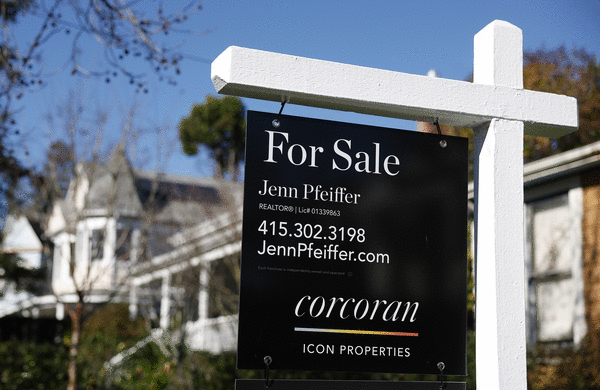
President Donald Trump’s bid to put home ownership in reach for more Americans is sputtering, just weeks after it launched.
With voters signaling that pocketbook issues are top-of-mind ahead of the November midterm elections, the White House has floated a series of trial balloons aimed at lowering the cost of buying a home, only to see several shot down by Congress, the financial industry or even Trump himself.
The result: About six weeks after he promised “some of the most aggressive housing reform plans in American history,” the administration has struggled to get new policies in place while mortgage rates recently inched higher. Trump acknowledged the corner he’s painted himself into, waffling about the very idea of bringing down housing costs if it means existing homeowners get hurt.
“We’re not going to destroy the value of their homes so somebody who didn’t work very hard can buy a home,” he said at a Cabinet meeting Thursday.
Trump’s inertia on the issue comes as a majority of Americans say he isn’t doing enough to address their broader cost-of-living concerns. A January CNN-SSRS poll showed that 64% of respondents said Trump hasn’t gone far enough in trying to reduce the price of everyday goods. A New York Times/Siena poll found that 51% of registered voters think Trump’s policies have made life less affordable, compared with 24% who think they’ve made life more affordable.
Housing is a particular sore spot for many Americans.
Home prices were up more than 50% from before the pandemic as of Nov. 30, according to the latest reading of the Case-Shiller National Home Price Index. Rents increased by about 35% over that period, according to Zillow, while the median age of first-time home buyers has risen to a record 40 years old, according to the National Association of Realtors.
Trump, meanwhile, has repeatedly gotten sidetracked, failing to tout the affordability proposals the White House signaled would form a central plank of his messaging heading toward November.
Before the president’s appearance this month at the World Economic Forum in Davos, Switzerland, aides had pitched his speech as an opportunity to expand on his plans. While Trump mentioned a few previously announced proposals, he didn’t offer fresh details and the speech was swallowed up by his remarks on Greenland.
Similarly, at a rally this week in Iowa — a key battleground in the November election — Trump failed to mention several of the affordability proposals at all.
He also directly panned one of his administration’s ideas to help Americans afford a home. After National Economic Council Director Kevin Hassett touted a forthcoming plan to let workers tap tax-advantaged accounts to fund down payments, the president told reporters, “I’m not a huge fan — other people like it.” People should leave their money in the market, he said.
The policies he does still support are ones he may have little power to enact.
Trump signed an executive order Jan. 20 designed to curb large institutional investors’ purchases of single-family homes. But the order is relatively toothless: It leaves it to Treasury to determine what counts as a large investor while urging Congress to pass legislation banning such sales.
Even if Congress carried out the request, it’s not clear how much impact such a move could have on prices. Larger institutional investors own less than 1% of the nation’s single-family housing stock, and just between 2% and 3% of its single-family rentals.
It’s not just housing policies that seem adrift.
House Speaker Mike Johnson dismissed a proposal Trump floated in a social media post to cap credit card interest rates at 10% for a year as an “out of the box” idea that shouldn’t be taken seriously. JPMorgan Chase & Co. CEO Jamie Dimon said the cap would spell “economic disaster.” It’s been little discussed since.
One move the administration announced that does appear to be underway is a plan to have Fannie Mae and Freddie Mac, the government-controlled companies underpinning the mortgage market, buy as much as $200 billion in mortgage bonds.
There are roughly $9 trillion worth of agency mortgage bonds outstanding, so if Fannie and Freddie carry out all the purchases it would amount to just over 2% of the market. The move could lower mortgage rates as much as 25 basis points, or 0.25 percentage point, according to analysts. The current rate on a 30-year fixed loan is 6.1%, according to Freddie Mac.
‘Needle-mover’
That might not be enough.
“If the expected effect of this is rates will come down 25 basis points, that’s not a needle-mover,” said Ed DeMarco, president of the Housing Policy Council and former acting director of the Federal Housing Finance Agency from 2009 to 2014.
Current FHFA Director Bill Pulte last week dismissed an AP report that the companies had been given a green light to expand their mortgage-backed security purchases in order to have a bigger effect on the market. In a post on X, he said “the combined incremental total MBS buy will not exceed $200 billion.”
But keeping the purchases capped means mortgage spreads will widen once the spending stops, according to Jim Parrott, a nonresident fellow at the Urban Institute, who said the move “will only impact the cost of a mortgage as long as investors believe the extra demand will be there.”
After the funding is spent, “the administration will have to decide if they want to spend another $200 billion to keep prices down for longer,” he added. “It may be hard for them to stop.”
———
(With assistance from Gregory Korte.)
©2026 Bloomberg L.P. Visit bloomberg.com. Distributed by Tribune Content Agency, LLC.


















































Comments