Broadband program uncertainty has lawmakers, states on watch
Published in Political News
WASHINGTON — The Trump administration has asserted for months that its “bargain” version of the federal $42.5 billion grant program to expand access to broadband internet would save taxpayers money. That made states and their representatives in Congress nervous that funds left over after deployment proposals would be clawed back.
Under pressure from senators at an appropriations hearing, Commerce Secretary Howard Lutnick last month sought to calm fears when he said that so-called “non-deployment” funds under the Broadband Equity, Access and Deployment, or BEAD, program would not be rescinded.
But with no guidance so far from the department’s National Telecommunications and Information Administration, which was expected but delayed this week, lawmakers and others are pushing to have their voice heard on exactly how states will be able to use the $21 billion pot of money.
Concern over the unallocated funds has been bipartisan. Senators on both sides of the aisle pressed Lutnick at the Commerce-Justice-Science Appropriations Subcommittee hearing — which was overshadowed by questions on his interactions with deceased sex offender Jeffrey Epstein — mentioning connectivity needs in their states that could be filled by the funds in areas such as remote health care and farming.
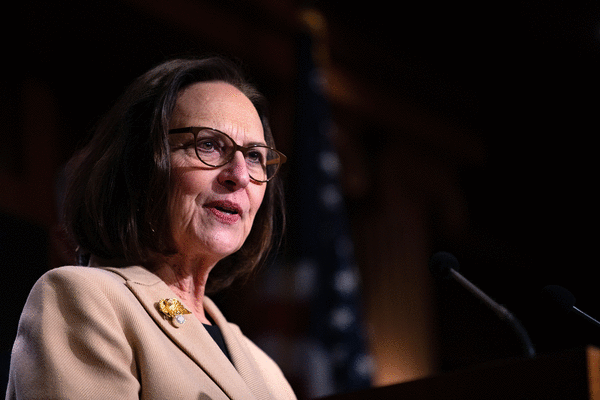
In December, a bipartisan group of senators joined a letter led by Sen. Deb Fischer, R-Neb., requesting clarification of NTIA’s timeframe for non-deployment guidance and on whether previously allowed uses might be changed.
Republicans for now are signaling that they have gotten their point across as they await the upcoming NTIA guidance. Fischer said last week that her “office has had really good conversations with NTIA, and I’m hopeful that we’re going to be able to repurpose those funds to meet the intent of Congress.”
At the February hearing, Sen. Lisa Murkowski, R-Alaska, asked Lutnick to commit that BEAD funds left over after deployment proposals would be used in line with congressional intent “to strengthen . . . all aspects of communication, particularly when it comes to . . . public safety communication . . . in these rural areas where you just have these incredible gaps, but also within the critical mile infrastructure.”
In response, Lutnick committed not to rescind the funds.
In a statement Tuesday, Murkowski called broadband “essential infrastructure” for her large, rural state.
“I appreciate NTIA’s recognition of the importance of the BEAD program to our state and its efforts to ensure that we are able to maximize this initiative so that every Alaskan is connected,” Murkowski said.
Sen. Katie Britt, R-Ala., who chairs the Homeland Security Appropriations Subcommittee, also expressed confidence in NTIA’s handling of the program under the Trump administration. In a statement, she said she wants “to make sure that the money spent through this program effectively closes the digital divide in rural Alabama.” She drew a contrast to the Biden administration in complimenting the current administration.
“I am thankful that Secretary Lutnick has prioritized speed and fiscal responsibility when finalizing these BEAD plans, and I look forward to continuing to work with him to ensure that zip code does not determine any Alabamian’s ability to achieve the American Dream,” she said.
Lingering skepticism
Democrats were more mixed on their expectations for the BEAD funds guidance.
Sen. Jeanne Shaheen, D-N.H., questioned Lutnick about a letter sent to states by satellite internet company Starlink, a subsidiary of Elon Musk’s Space X, that would have modified the terms of the BEAD grants the company received. But Lutnick said the rider was outside of NTIA guidelines, and Shaheen said this week that she was satisfied with that answer.
“Secretary Lutnick assured me that we were going to be able to deal with the contractors who have reneged on the original agreement. So I’m going to give them the benefit of the doubt,” Shaheen said.
On Tuesday, House Energy and Commerce ranking member Frank Pallone Jr., D-N.J., sent a letter to NTIA, noting that because of changes to the BEAD program last year to prioritize the cheapest broadband options, rather than fiber optic in most cases, more money was at stake in deciding how to use non-deployment funds. Two subcommittee chairs, Reps. Doris Matsui, D-Calif., and Yvette D. Clarke, D-N.Y., joined the letter.
“States will have to balance numerous priorities, such as addressing inevitable defaults, filling in widespread gaps in connectivity, and ensuring residents have the skills and means to get online,” they wrote. They went on to note that Congress’s rules for the money were intentionally broad to address different needs in different places.
“As a result, NTIA cannot prohibit or limit a state’s use of the nondeployment funds, so long as that use is consistent with the broad parameters” set out in the 2021 infrastructure law that created the program, they wrote.
They also pressed against any limitation on BEAD funds as a result of President Donald Trump’s executive order in December that said states that enact certain artificial intelligence restrictions would see funds withheld.
“Any effort to restrict or withhold funds because a state or territory has adopted laws or regulations to protect against harms from artificial intelligence is blatantly unlawful and a clear impoundment of appropriated funds,” they wrote. “NTIA should not risk tying up the BEAD Program in years of legal challenges and further delaying its already overdue implementation.”
Potential uses
NTIA Administrator Arielle Roth said in a statement that while guidance on the funding was expected this week, the administration would be “taking additional time” to “ensure these funds are spent as efficiently and responsibly as possible.”
In February, NTIA held two public listening sessions and one private session with states to hear from stakeholders about how the funds should be used. In the statement, Roth said that over 1,700 people attended the sessions, in addition to written comments.
Up for grabs are four specific non-deployment uses for grants established in the infrastructure law: connecting community anchor institutions, data collection and broadband mapping, installing internet infrastructure in multifamily housing and broadband adoption programs. It also left open the possibility that funds could be used for “any use determined necessary” by NTIA “to facilitate the goals of the program.”
In her statement delaying the release of NTIA’s guidance, Roth said that during the listening process, the administration heard suggestions that the funding be used for “funding permitting improvements and workforce-related training, enhancing public safety communications, and using some of the funding to ‘clean up’ any remaining unserved locations.”
In a previous statement following the first public listening session, NTIA highlighted interest in using the grants for Next Generation 911, streamlining permitting, addressing screentime in classrooms and broadband resilience and redundancy.
The Benton Institute for Broadband & Society, a foundation focused on promoting inclusive broadband policy, released data on the non-deployment uses that speakers at the public listening sessions mentioned.
The leading use on that list was “broadband adoption,” including affordability, device access and digital literacy. The data showed that adoption was mentioned by speakers 43 times. Workforce development related to broadband got 22 mentions and broadband affordability got 13. Regional or local flexibility was also mentioned 13 times.
At the February hearing, Murkowski mentioned the possibility of using the funds to support telehealth or cybersecurity, while Sen. Shelley Moore Capito, R-W.Va., mentioned the cost of permitting and pole attachments. Fischer asked that NTIA consider the needs of precision agriculture.
With so much input and no clear date for guidance from the Trump administration, Sen. Gary Peters, D-Mich., put it plainly last week.
“I have no idea what they’re going to do, and I suspect they don’t know yet either what they’re going to do,” Peters said.
©2026 CQ-Roll Call, Inc., All Rights Reserved. Visit cqrollcall.com. Distributed by Tribune Content Agency, LLC.











































Comments