Greg Cote: World Baseball Classic, sports' unifying power needed right now
Published in Baseball
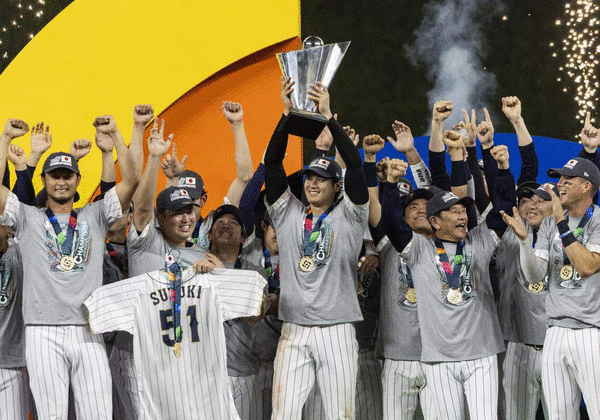
MIAMI — Us against the World is all the rage as the international World Baseball Classic begins with Miami again serving as main host and hub city.
The sixth iteration of the 20-nation, 20-year-old tournament running March 6-17 is a celebration of the power of sports to unite, but it arrives this time shadowed by geopolitical conflict.
U.S. against the World is a bit too real life at the moment as America jails the president of Venezuela (which is playing in the WBC) and now joins forces with Israel to bomb Iran. Israel’s team also in playing in the WBC, in Pool D playing in Miami.
Sports and sports fans don’t have blinders big enough to ignore real life or pretend it doesn’t affect the fun and games.
Iran’s men’s soccer team is scheduled to play this summer in the FIFA World Cup being hosted by the United States, Canada and Mexico, including seven matches at Miami’s Hard Rock Stadium. Now, Iran’s participation is in doubt.
“What is certain is that after this attack, we cannot be expected to look forward to the World Cup with hope,” said the president of Iran’s soccer federation, Mehdi Taj.
Iran and the U.S. would face each other on the field in a game in Dallas on July 3 if both finished second in their groups. So much for keeping real life out of sports, right?
As it is, what’s happening in Iran is affecting sports beyond its borders, from interruption of travel affecting Formula One races to tennis tournaments to soccer matches in Qatar and cricket matches in Abu Dhabi. South Carolina women’s basketball coach Dawn Staley spent the weekend asking for prayers on social media as three of her former players are unable to leave Israel, which is facing counterattacks by Iran.
The World Baseball Classic itself has not been immune from politics mixed with the pitches.
It happened intensely in the previous WBC held in 2023 when the U.S. and Cuba played in a semifinal game at the Marlins’ stadium in Little Havana. There was a cocktail of emotional protests but also support for the Cuban team from Miami’s Cuban exile community. Amid an otherwise festive atmosphere protesters condemned Cuba’s government, and fans in the ballpark chanted “Patria y Vida” (homeland and life) and lifted signs for political prisoners.
There was no interest, or ability, to pretend Cuba playing in Miami did not inflame emotions beyond sports.
It is despite this combustibility of geopolitical effect on our fun and games — or as likely because of it — that Us against the World has become a big sell in sports.
You’ll see that as the WBC unfurls in Miami, which is hosting 10 group-play games March 6-11 in Group D with the Dominican Republic, Israel, Netherlands, Nicaragua and Venezuela. The Marlins’ home park will also host quarterfinal games March 13-14, semifinals March 15-16 and the championship game March 17.
Many of these games will draw crowds that dwarf those of a Marlins game. The Dominican Republic, especially, will fill the stadium with a party, a cacophony of music and celebration.
The Us against the World factor in the WBC: America invented baseball, and 73.5% of all MLB players in 2025 were U.S.-born. Yet Japan has won three of the first five WBCs including the last one in ‘23, while the U.S. team has won only one, in 2017. The Dominican Republic won the other one.
Us vs. everybody else sells.
That’s partly why U.S. TV ratings for the recent Winter Olympics in Italy were up 96% from the 2022 Games, and the most-watched since 2014. Us against the World quantified itself in the medal count (the Americans were second to only Norway) and culminated when America’s NHL players beat Canada’s NHL stars for the gold medal.
The NHL’s 4 Nations Face-Off last February also stoked massive interest, again fueled by a U.S.-Canada rivalry that American Brady Tkachuk described as, “There’s hatred there.”
The NBA took a cue from the 4 Nations success and redesigned its recent All-Star Game into American players vs. foreign stars. There was a palpable uptick in the intensity of competition, and TV ratings jumped 87% from the previous year.
Even America’s King Sport — the mighty NFL — is saying “We want some o’ that” with its increasing globalization. The NFL in 2026 will play a record nine regular-season games overseas: Three in London and one each in Madrid, Munich, Mexico City, Rio de Janeiro, Melbourne and Paris.
NFL commissioner Roger Goodell calls a future franchise outside the U.S. “very possible” and recently formed a Global Markets Program, granting teams international marketing rights to build brand awareness and grow fans overseas. (The Miami Dolphins have rights in Argentina, Brazil, Colombia, Mexico, Spain and the United Kingdom.)
The World Baseball Classic that renews this week was formed in 2006 and has become a major player in the globalization of games, and it’s only fitting that Miami, a most international city, has come to be the main host.
Even when real life means to divide the world, sports is a more powerful force than ever in its ability to unite.
____
©2026 Miami Herald. Visit miamiherald.com. Distributed by Tribune Content Agency, LLC.





Comments