College basketball betting scheme allegations 'tip of the iceberg,' academics say
Published in Basketball
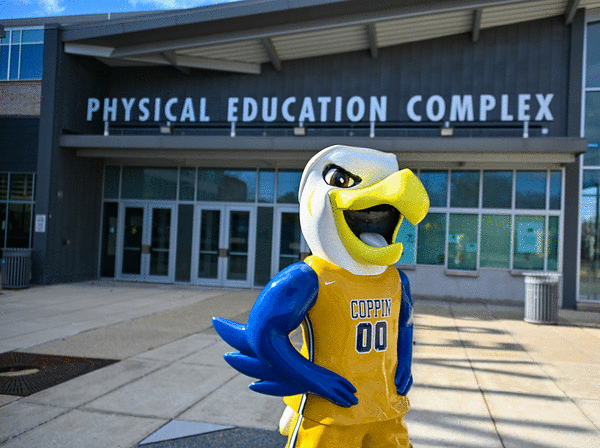
BALTIMORE — Thursday’s startling allegations that 17 NCAA Division I men’s basketball programs — including Coppin State — were involved in a massive gambling scam to rig games isn’t likely to be the last such incident involving athletics and sports betting, academics said.
In fact, Keunsu Han, an associate professor of sport management at Towson, is surprised that more cases have not surfaced yet.
“This is just the tip of the iceberg,” he said. “We have thousands of college basketball programs, but only 17 schools were involved in this type of event? It’s very hard to believe that. It’s a big concern. This is not just an individual issue. This is a structural issue in the American college sports system.”
Milton Kent, a professor of multimedia journalism at Morgan State, echoed that sentiment.
“You don’t want to get overly nervous about this stuff, but there’s no question that as more and more money gets funneled into the system, where there’s less money, people will look for it,” said Kent. “And I have no doubt that athletes at smaller schools are going to be looking for their piece of the pie.”
The Eagles were named in a federal indictment unsealed Thursday. According to the 70-page legal filing, a group of defendants described as “fixers” bribed an unnamed Coppin State player to alter his playing style to affect the outcome of an Eagles game against South Carolina State on March 4, 2024.
Before the game, the Bulldogs were favored to win by nine points on betting sites in the United States. According to the indictment, the defendants placed wagers on South Carolina State to cover the spread and directed others to bet the spread.
But with the halftime score tied at 30, a defendant, Jalen Smith, 30, of Charlotte, N.C., Carolina, is alleged to have texted the Coppin State player to remind him of what was at stake if the Eagles did not lose by 10 points or more.
“U supposed to be f—— losing[,] you costing us money,” Smith wrote in part. “Get yo ass blow[n] out next half bro.”
The Bulldogs pulled ahead in the second half, but won by only three points, 61-58. That outcome cost the bettors.
After the game, the player replied to the defendant and blamed South Carolina State’s poor play for making it impossible to influence the final score.
On Friday, Coppin State president Anthony L. Jenkins emphasized that no current student-athletes or staff are subjects of the indictment.
“The indictment focuses on a single former player who is no longer associated with the team or enrolled at Coppin State University,” Jenkins said in a written statement. “Behavior of this nature falls below the high standards we set for our students at Coppin and will not be tolerated. We remain committed to fostering a culture of integrity, accountability, and excellence across campus.”
The indictment says that fixers offered players payments often ranging from $10,000 to $30,000 per game. Fixers delivered cash payments, traveling to campuses and directly paying athletes who helped rig games.
Tom Rhoads, a professor of economics with an emphasis in sports at Towson, said that he wrote a paper long ago that concluded that big-money donors tend to withhold their contributions to their alma maters and favorite schools if their basketball program is on probation. He warned that a similar situation could unfold with the Eagles.
“If I was Coppin State and their athletic department, I would be incredibly nervous right now with what’s going to be happening to their program and their recruiting and their alumni contributions and things like that and all the other programs that are caught up in this,” he said. “So it is a sad day for that. People have to start thinking, ‘How do we make sure this doesn’t come to this point in the future again?’ ”
With the exception of DePaul, which is a member of the Big East conference, the schools named in the indictment Thursday field teams described as mid-major and play in leagues outside the Power 4.
Robert Sroka, an assistant professor of sports management at Towson, said that distinction is significant because gamblers can successfully recruit student-athletes from smaller programs who are not earning as much from name, image and likeness avenues as their peers from the Power 4 conferences.
“The fixers were seemingly profiling a certain type of player at a certain type of lower-tier D1 school like Coppin State — namely, players that could have enough influence on the game to meaningfully shave points in a half (whether directly through scoring or defense, or indirectly through soft influence on teammates) but wouldn’t have enough NIL opportunities to override the risk of getting caught,” he said via email. “Games at lower profile programs tend to be more difficult for bookmakers to set lines for in the first place, so many legitimate professional gamblers operate in that space anyway.”
The scheme, which has ensnared 26 individuals including more than a dozen college basketball players who attempted to exploit games as recently as last season, originated from bets on games in the Chinese Basketball Association. Han said that was also intentional.
“Historically, it’s a very smart choice as a fixer to choose unpopular sports events and players,” he said. “If the event is unpopular, there’s less media attention and interest, and it’s easier to manipulate. But the sportsbooks will offer the full betting market. So there’s a lower risk [for the gambler]. And this is not just American sports. All over the world, these types of events are what the fixers choose.”
In a different case in March 2024, Loyola Maryland dismissed a player from the men’s basketball team after determining that the individual had gambled on games. Ryan Eigenbrode, associate athletic director in charge of communications and strategic marketing at Loyola Maryland, said that all student-athletes and coaches participate in education sessions through the NCAA Social Series Gambling Risk Education Program.
The University of Maryland has access to Integrity Compliance 360, which monitors the sports betting market through a partnership with the Big Ten. Athletic director Jim Smith said that IC360 representatives are scheduled to meet with the men’s and women’s basketball teams in a few weeks.
“At Maryland Athletics, we take our responsibility to educate and protect our student-athletes very seriously, especially when it comes to sports gambling,” Smith said in a statement. “Our student-athletes are empowered with knowledge, supported by our compliance staff, and reminded that integrity is the foundation of college athletics.”
Sports gambling continues to surge. According to figures from the Maryland Lottery, bettors in the state wagered more than $6.5 billion in 2025, more than a 10% jump from the previous year. As of early 2026, 38 states, Washington, D.C., and Puerto Rico have legalized sports betting.
For that reason and how the federal government has “disempowered” the NCAA, Kent said he’s not sure what the answer is. He compared the situation with a black hole.
“I think it has to sort of collapse on itself, and then whatever comes from it, that will be the solution,” he said. “This is going to be a problem for some time to come because there’s no good reason for people in the right positions to fix this. There just isn’t. So long as television and betting are out there, there’s no reason for this stuff to get fixed anytime soon.”
©2026 The Baltimore Sun. Visit at baltimoresun.com. Distributed by Tribune Content Agency, LLC.



Comments