Timberwolves respond to Rudy Gobert's comments: 'That's been addressed'
Published in Basketball
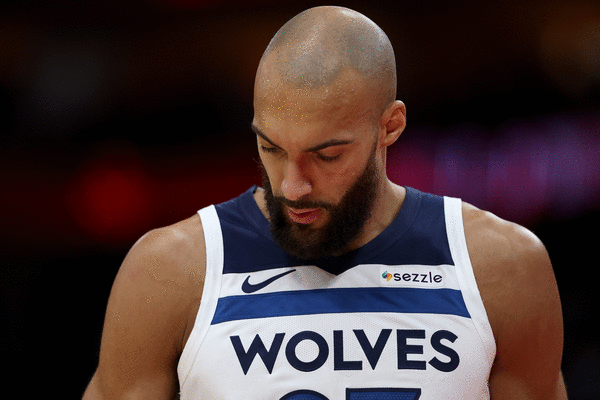
MINNEAPOLIS — When asked about Rudy Gobert’s comments from the Timberwolves’ loss to the Pelicans, the comments in which Gobert said it was about time for coach Chris Finch to start benching those who don’t give effort on defense, Jaden McDaniels smiled and turned into a politician.
“I don’t know nothing ‘bout it. I don’t even wanna talk about it, for real,” McDaniels said Saturday. “I just try to do my job, and do my job to the best of my ability.”
There wasn’t much those who spoke wanted to say publicly about Gobert’s comments, which were among the strongest the three-time All-Star center has delivered in his postgame tenure in his four seasons with the Wolves. Gobert said Finch should start benching players, regardless of stature on the team, if they don’t try on defense.
While he didn’t name names, his comments seemed to be pointed toward star offensive players such as Anthony Edwards and Julius Randle, whose effort can wax and wane on that end of the floor. Gobert was the last Wolves player or coach to speak after Friday’s loss to the Pelicans, so Saturday’s practice was the first time Finch and the team addressed what Gobert said (Randle was requested for interviews but was unavailable, the team said).
“Well aware of his comments,” Finch said. “I’ll say a couple things, one is anybody knows how we do things here knows there’s a high degree of accountability. Secondly, I handle all my conversations with ourselves in house. Disappointing that he felt the need to go outside. But nonetheless, that’s been addressed already today. There’s never been a team that’s won anything meaningful that has substituted their way there.”
Finch has been up front that the Wolves can be a “moody” team that wears its emotions on its sleeve. So when he goes back to look at the film from a game like New Orleans — when the Pelicans were beating the Wolves in transition and the Wolves were leaving open shooters on the perimeter — it was easy to see where the lapses in effort were.
But Finch added, “A lot of times in film, it doesn’t pick up the mood of the team.”
“I think a lot of our low-energy plays comes from a collective kind of foul mood,” he said. “So those are things that I try to identify. Transition defense is most obvious one for us — bit of a litmus test for our mood and our willingness to make that play.”
Edwards recently said he recognizes when he plays defense, it picks up the rest of the team, but he also admitted it’s hard for him to do on a nightly basis given his offensive responsibilities. Finch said he didn’t necessarily subscribe to that philosophy.
“I realize that to be a 30-point-a-night scorer in the league is a hard thing to do. All I would say is offense doesn’t have to be as hard as you make it, either,” Finch said. “Where you put your energy certainly matters, and I think there’s opportunity to maybe re-balance the scales with simpler offense and more defense.”
The Wolves are adding more defense to their mix with the debut of Ayo Dosunmu after they acquired him from the Bulls at Thursday’s trade deadline. Dosunmu practiced and is set to make his debut against the Clippers on Sunday.
McDaniels did say that there was a camaraderie on the team that has helped this particular group navigate the rougher patches of the season. In his sixth NBA season, he has been through these ups and downs many times, and Gobert’s comments didn’t sound like they were going to rock the team to the point it topples over.
“We all hang out, we all like each other,” McDaniels said. “So I feel like that gets us through just wanting to play with each other, wanting play for each other. Like how we went through that five-game losing streak or whatever it wasn’t like a … cloudy day every day, just because we still respect and like each other as teammates. So I mean, as we can get through it together, I feel like we’ll be OK.”
©2026 The Minnesota Star Tribune. Visit at startribune.com. Distributed by Tribune Content Agency, LLC.





Comments