What does another early March Madness exit mean for UNC basketball, Hubert Davis?
Published in Basketball
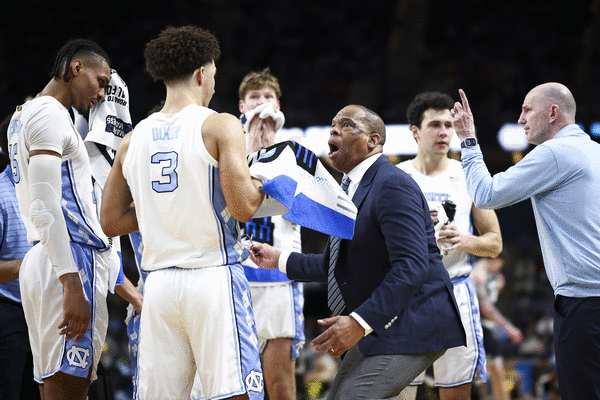
GREENVILLE, S.C. — VCU’s Lazar Djokovic said it plainly on Wednesday: “We play against UNC, but we don’t play against the brand.”
The next day, just before the two teams faced off in the NCAA Tournament first round, North Carolina senior guard Seth Trimble reminded his teammates of those words: They’re not respecting the brand. Let’s go be the brand.
For about 27 minutes, North Carolina did.
Then, it didn’t.
No. 6 seed UNC collapsed from a 19-point second-half lead and fell, 82-78, in overtime to No. 11 seed VCU on Thursday — a game that will be remembered not only for being the largest first-round comeback in NCAA Tournament history, but for what it says about the direction of one of the sport’s defining programs.
North Carolina boasts six national titles, along with the most wins (134) and Final Four appearances (21) in NCAA Tournament history. The Tar Heels are second all-time in NCAA Tournament appearances (55) and games (185) behind Kentucky. They’re second all-time in winning percentage (.724) behind Duke.
But UNC’s inconsistency over the past decade — and the Hubert Davis era, in particular — is now part of its brand, too.
North Carolina’s two first-round losses over the past two years are as many as it has had in its previous 35 NCAA Tournament appearances. The Tar Heels have now lost in the Round of 64 in consecutive tournaments for the first time since the tournament expanded to 64 teams in 1985.
After the loss Thursday night, Trimble talked about wanting to take the Tar Heels back to a one seed. Back to being a top-10 team in the country. He sat on a training table in the corner of the locker room, fidgeting with his athletic tape as he described his desire for the program to get “back to dominating.”
“We’ve shown that we can do it in recent years — but it hasn’t been consistent,” Trimble said. “I don’t really know where it’s at, but it’s gon’ get back.”
North Carolina (24-9) led 56-37 early in the second half and 70-56 with just over seven minutes remaining before unraveling in epic fashion. The Tar Heels did not make a field goal over the final 7:44 of game time, including overtime.
UNC finished with three points in the extra period — all from the free-throw line. Of the 758 overtime periods played this year, per Evan Miyakawa, teams scored more than three points 97.6% of the time.
The Tar Heels, in that sense, are in rare air.
“lt was unreal... we were up too, so I felt like we had won the game, and then the way we lost it is, like, even worse,” said junior forward Henri Veesaar, who led the Tar Heels with 26 points and 10 rebounds. “When the buzzer hit, everything in my body felt like it left. I just like, I don’t know how to express it. It’s a horrible feeling.”
Lack of March Madness success alarming
For Davis, it marked another difficult postseason exit in a tenure now defined as much by its bumps as by its early high point. North Carolina has advanced past the opening round once in the past four tournaments and is 3-3 in NCAA Tournament play since its magical run to the 2022 national title game.
That run — which included instant-classic wins over Duke in Cameron Indoor Stadium and the Final Four, ending Mike Krzyzewski’s career — remains the defining achievement of Davis’ tenure. It has also become the standard against which everything since is measured, at a blue blood program where the standard is already exceedingly high.
The results have simply not matched it.
Since that six-week surge, North Carolina has missed the tournament once, reached one Sweet 16 and now suffered back-to-back first-round exits. Three of Davis’ four NCAA Tournament losses have come after leading at halftime.
There have been six blown 15-point leads in the past eight years of The Big Dance. Davis’ Tar Heels are responsible for two of those.
After Thursday’s loss, Davis was subdued, direct and curt. He rejected fatigue as a factor in the loss despite playing a shortened six-man rotation for the second half. Davis said he did not believe his team tired and argued the substitution patterns were “my decision” without further elaboration.
When asked about the program’s broader trajectory after back-to-back early exits, he declined to engage.
“That’s a big thinking question,” Davis said. “And I apologize, I’m just not there right now. Just really sad that we’re not continuing to play and to move forward.”
Caleb Wilson injury lowered UNC potential
The loss closes a season that requires context. North Carolina lost All-American freshman Caleb Wilson — its leading scorer and once-in-a-generation NBA prospect out of UNC — for the final nine games due to injury.
With Wilson, the Tar Heels recorded wins over Kentucky, Kansas and Duke. They resembled a top-10 team.
Without him, the margin for error shrank. The ceiling lowered.
Even so, the nature of Thursday’s defeat — extended droughts, late-game execution failures and visible fatigue — reinforced familiar concerns and will prompt reflection in the offseason.
North Carolina remains one of college basketball’s most resourced programs, with a roster built through high-level recruiting, transfer additions and bolstered NIL backing. It’s also operating in a rapidly evolving landscape shaped by the transfer portal and increased financial pressure in the revenue-sharing era — changes that university leadership, including chancellor Lee Roberts and incoming athletic director Steve Newmark, are actively navigating.
Davis has won at least 20 games in each of his first five seasons — the only ACC coach in conference history to do so — and guided North Carolina to an ACC regular-season title in 2024.
But the standard in Chapel Hill has historically extended beyond that — to sustained postseason success and regular national contention.
“Play the team, not the brand,” longtime coach Phil Martelli Sr. told his son before VCU faced UNC. “The brand is phenomenal. But the team had to play this game.”
On Thursday, the team did not finish it.
What’s next for UNC and Hubert Davis?
What follows is less clear. Davis is under contract through 2030, and program leadership is unlikely to make immediate decisions in the wake of an emotional loss. The transfer portal opens April 7, accelerating the timeline for roster construction regardless of any broader evaluation.
In the short term, North Carolina will absorb the shock of one of the most significant collapses in its tournament history.
Longer term, it must decide what that collapse represents — an outlier shaped by injury, or a continuation of a trend.
And whether, for a program of this stature, the current trajectory is acceptable.
©2026 Raleigh News & Observer. Visit newsobserver.com. Distributed by Tribune Content Agency, LLC.





Comments