Florida AG wants the Rooney Rule to end despite ineffectiveness
Published in Football
MIAMI — The Rooney Rule doesn’t even necessarily work.
And yet the Florida Attorney General wants to get rid of it.
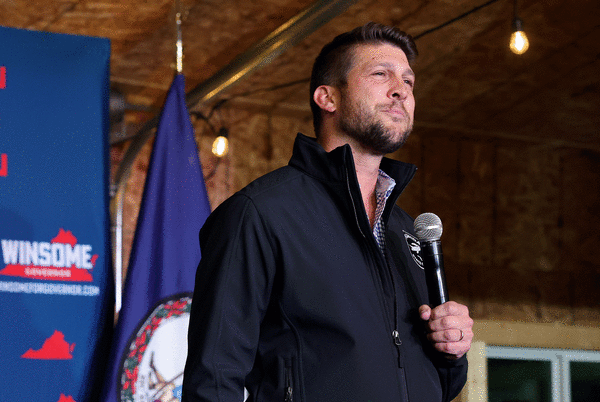
In a letter sent to NFL commissioner Roger Goodell with a host of team owners CC’d, including the Miami Dolphins’ Stephen Ross, Florida Attorney General James Uthmeier called for the end of the policy that mandates teams interview at least two minority candidates for open head coach, general manager and executive positions. Uthmeier specifically cites the Florida Civil Rights Act, explaining that the Rooney Rule stands in violation.
“They require teams to limit, segregate, and classify applicants for certain employment and training opportunities because of race and sex,” Uthmeier wrote. “And they do so in a way that tends to deprive applicants of opportunities for employment.”
Uthmeier also threatened legal action if the NFL fails to “confirm no later than May 1, 2026” that its three Florida teams — the Dolphins, Jacksonville Jaguars and Tampa Bay Buccaneers — no longer enforce the rule. NFL executive vice president Jeff Miller has since responded via statement.
“We are reviewing the letter,” Miller wrote. “We believe our policies are consistent with the law and reflect our commitment to fairness, opportunity, and building the strongest possible teams.”
The issue: the very people that the Rooney Rule was designed to help still rarely get the opportunities. As of this writing, there are only five minority coaches, a number that took a hit after the retirement of longtime Pittsburgh Steelers coach Mike Tomlin. The last hiring cycle had 10 head coach openings, the most in NFL history, yet not a single Black person was hired. Only the Tennessee Titans saw it fit to hire a minority in Robert Saleh.
Uthmeier would like people to believe the Rooney Rule, which the league created to promote “diverse leadership among NFL clubs to ensure that promising candidates have the opportunity to prove they have the necessary skills and qualifications to excel,” significantly prevents white applicants from advancing.
“People with race and sex characteristics that the NFL doesn’t like are deprived of employment and training opportunities available to people with race and sex characteristics that the NFL likes,” he wrote. “This policy is blatant race and sex discrimination. And it is illegal under Florida law.”
What makes this letter particularly puzzling is the open court case that accuses the NFL of racial discrimination. In a 2022 lawsuit, former Dolphins coach and current Minnesota Vikings defensive coordinator Brian Flores claimed that the NFL’s hiring practice, specifically when it came to Black coaches, was “rife with racism.” Two other plaintiffs, coaches Steve Wilks and Ray Horton, had their similar cases folded into that of Flores.
In the lawsuit’s latest development, the U.S. District Court for the Southern District of New York ruled that the case must be heard in open court. This was huge win for the plaintiffs considering the court previously attempted to shift the case to the league’s internal arbitration process, a move that attorneys argued would eliminate all impartiality.
“The court’s decision recognizes that an arbitration forum in which the defendant’s own chief executive gets to decide the case would strip employees of their rights under the law,” Douglas H. Wigdor and David E. Gottlieb, the coaches’ attorneys, told ESPN in a statement in February. “It is long overdue for the NFL to recognize this and finally provide a fair, neutral and transparent forum for these issues to be addressed.”
Enacted in 2003, the Rooney Rule was designed to increase the hiring of minorities. More than two decades later, however, criticism of the policy’s ineffectiveness has reached new heights as detractors argue the rule can be easily skirted as there’s no oversight.
“The Rooney Rule is the only rule that I have ever seen in the history of the National Football League that they don’t follow, and they don’t enforce,” DeMaurice Smith, the former executive director of the NFL Player’s Association, said during an interview with Pro Football Talk. “They have nobody that they’re accountable to, nobody to answer to.”
Added Smith: “In a closed system where they are accountable to no one, these owners simply do whatever they want to do.”
____
©2026 Miami Herald. Visit miamiherald.com. Distributed by Tribune Content Agency, LLC.





Comments